Thursday, September 22, 2022

Witches, Part 1


What distills from pain but pure, delicious rage?
Art by Sackcloth & Ashes

There are two distinctive schools of thought within the artisinal schools of The Republic: that the universe can be understood by studying how reality is warped through tangible things, representing The Occult, and that these things can only be known by that which exists beyond our purview. Although efforts have begun in recent to understand the paranormal effects brought by the conjunction, such as that of the Elkem's Yr Drannas, their discoveries are in infancy, and resources are spread thin between the two. Occult fields receive more praise, as well as most of the funding.

It is well-known that there are forces which operate far beyond our mortal understanding. Population centres are haunted by the presence of the Mirage, Artisans are ripped apart by flaws exposed through chaos, and even the continent slowly cracks under the weight of an perpetually stormy sky. Hardship and strife have always been relevant to humanity's progress—even in peacetime—but when the world became too dark to navigate on instinct alone, our torchlight burned away the very shadows which comforted us.

In the past, those soothing things went by many names; The Eldermen, The Divine, Faith. Pieces of the collective desire for comfort. For purpose. Being. Things that could be seen but not identified, spoken to yet unheard. They are utterly inhuman, by both action and design, and yet also living proof of a progenitor.

We abandoned them. Left the old world behind, tossing away or, at times, incinerating, what was meant to be a timeless bond, as if logic could not co-exist with us. But they could not be destroyed. They could not be forgotten, for we were now but a guest, and how exactly does one treat a neglectful guest?

We still have not left.

Bubbling Oils

The Primeval Forces is a catch-all phrase for some of the mysterious energies permeating Bromeilles, specifically those that draw their identity to the "old world". Its possesses worshipers in many forms, most notably druids and various nature spirits, but also offers powerful (and repugnant) gifts to all that are willing to reach out to it.

Witches are one such group: members of a commune type believed to date back to pre-storm practices. Although they may have relied solely on the primeval at some point, or may have even been druids themselves, modern Witches have been co-opted into the Artisinal Schools.

Witches represent a serious minority of occult-casters in The Republic. This is largely due to the trouble surrounding their recruitment, as while artisans are sourced from all backgrounds, walks of life and identities, Witch covens are prohibitively feminine. Multiple theories exist to explain why this decision was made—several of which may be true, as covens and witches alike continue to form sporadically into the modern day—but the covens themselves appear disinterested in this game. If prompted, many offer similar sentiments: that groups of women sought to learn in an environment that suited their particular needs and amenities, rather than what superiors considered comfortable.

Note: While I am interested in exploring themes such as casual sexism and the effectiveness of a collective response to its grasp, it's fair to say that not everybody will be comfortable reading or playing around that material. Not every setting needs sexism for a compelling story or world, nor does it need racism, classism, or other forms of bigotry. Create according to the material you wish to emulate and the narrative you'd like to create. If it cannot be omitted, that's fine. Nobody has to like it.
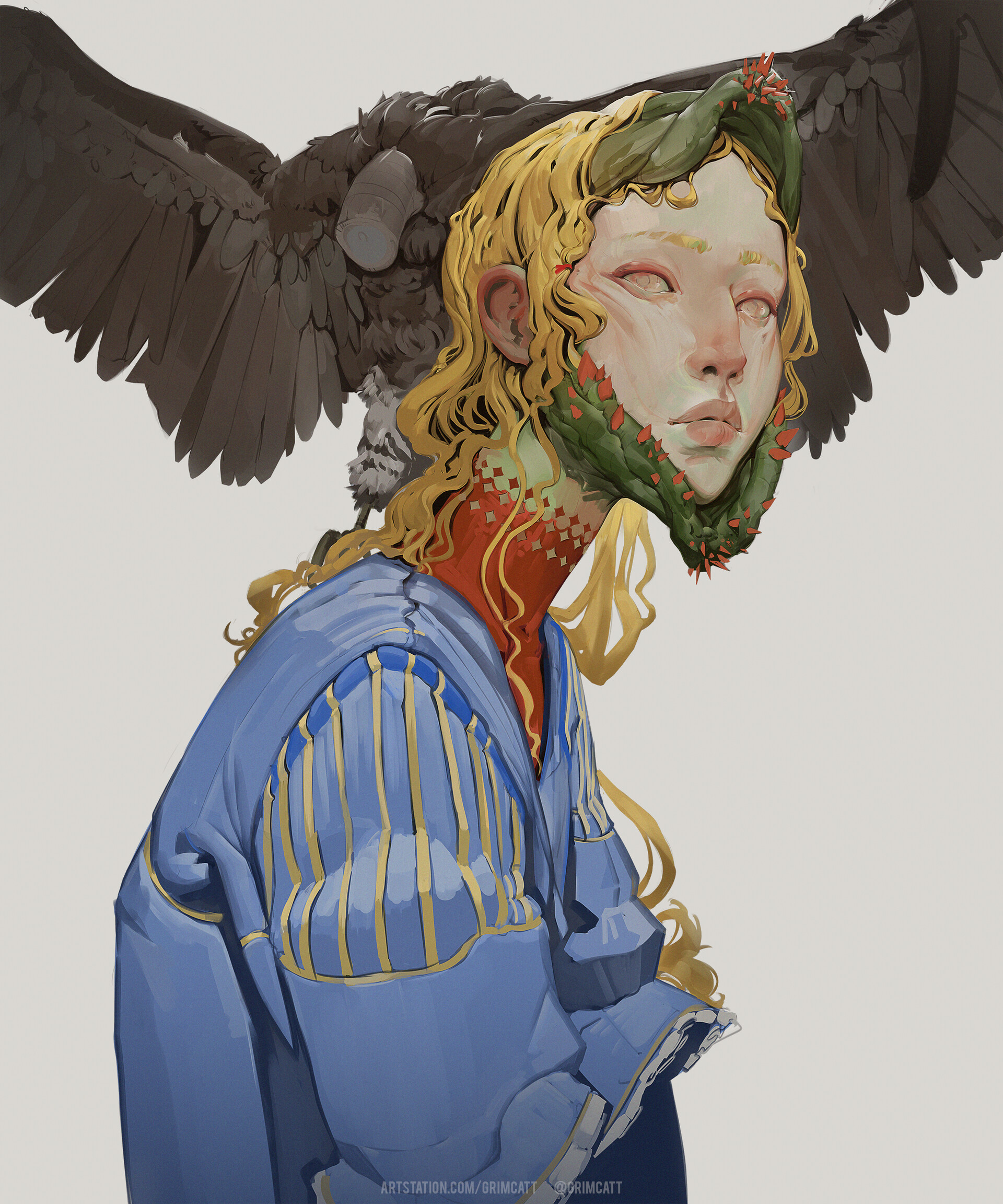
By the way, feminine doesn't mean born a woman.
Art by Aleksander Brodzinski


Of the many covens discoverable throughout the continent, only two lie beneath The Republic's jurisdiction
—specialized institutions overseen by the Artisinal Schools and yet fundamentally different in structure. The rest are considered products of circumstance, begrudgingly acknowledged and marked down in ledgers for the cartographer. Many of these wild covens are cordial towards The Republic, and are oftentimes viewed favorably by nearby villages, who they provide medicine and other boons. 

Legally, their existence is suspect. Although common concerns exist regarding the dangers of unchecked magical practicioning, this is not unique to Witches, and thus they sit low on The Republic's priority list.

Broiling Cauldrons

Witches rarely devote themselves entirely to acts of the Primal; instead, they combine Occult magic with profound, more applied techniques. The Republic makes a distinction between their work and the work of an Artisan, for Witches combine the effects of both worlds, creating a field of study utterly alien to its contemporaries.

Perhaps due to their internal complexity, Witches are notably exempt from The Twelve Laws. It is unclear whether this decision was made merely to distinguish the two groups or as a result of opposition.

Community

The vast majority of covens in Bromeilles are decentralized. While the number of would-be witches aspiring to join the academic covens is great, they are a minority compared to those filled with runaways and convicts. 

When you dress only for the sky, we all dazzle like stars.
Art by Qistina Khalidah

Joining a coven is a lifelong commitment. Initiation is required, a pledge to one's oaths or tenants, and a pact of loyalty to your new sisters which stretches beyond the realms of life and death. Your fellow witches are your teachers, your Matron most of all, but they are also your students. Covens are an open space for honesty, discussion and evolution. It is somewhat of a jarring environment for Artisans to visit; members openly cry and shout obscenities at each other, and failure is not reprimanded with heavy hand.

Every coven holds true a different set of beliefs. Like any institution, witches attract different individuals and promote certain kinds of behavior according to their values. Organized most typically by region and the primary source of magic they practice, Witch Schools are frequently associated with color, and every witch has at least a rudimentary understanding of both forms of power.  


Coven Magic

  1. White Magic: Unity, Purity, Health, Nurturing
  2. Black Magic: Death, Protection, Compulsion, Individuality
  3. Red Magic: Passion, Energy, Violence, Concentration
  4. Blue Magic: Creativity, Patience, Understanding, Wisdom
  5. Green Magic: Empathy, The Natural, Peace, Health
  6. Purple Magic: Acuity, Spirituality, Manipulation, Perception
  7. Orange Magic: Change, Luck, Creativity, Goodwill
  8. Tide Magic: Balance, Control, Freedom, Strength
  9. Lunar Magic: The Natural, Secrecy, Family, Freedom
  10. Blood Magic: Health, Spirituality, Individuality, Control
  11. Steel Magic: Violence, Balance, Compulsion, Patience
  12. Tea Magic: Kindness, Balance, Perception, Spirituality


Monday, September 19, 2022

Mind Before Matter

    Around 1440 AD, the german inventor Johannes Gutenberg introduced Europe to the sublime gift of the printing press. His own twist on the invention sent shockwaves throughout the continent, having effects potentially unknown even to him at the time. Literary skyrocketed, hierarchies shattered, and all of a sudden the educated elite found themselves privy to reading the same material as serfs, who happily flipped away at their own copy of the bible. Johannes Gutenberg changed hundreds of millions of lives in a thousand unforeseen ways, and his contributions (as well as his contemporaries in the east) have objectively changed our society for the better. 

How much information do you think a book can store? Theoretically the answer is an infinite amount, because all you would have to do is shrink the font and increase the number of pages, but how much information really is that? We consider a novel that's less than 200 pages a novella, which somehow isn't a book but is also just enough detail to be considered complete. Dictionaries are hundreds of pages of words, with definitions for those words, using the exact same terms it defines. One of the grandest pieces of literature of all time is a Super Smash Bros fanfiction. It's over 4,000,000 words long.

But knowledge is cumulative, and just because you write something doesn't mean it has any intrinsic intellectual value. A monkey with a typewriter could write all the most extraordinary works that'll ever exist, but it would have to type gibberish first. Who's going to supply all of that paper? Is there something to be salvaged in the pile of scrap? Should we make a book out of it?


Imagine this is your brain. Or maybe you're an evil zoologist.


Our brain answers these questions monotonously and with a mere (on average) 20 watts of energy. Constantly and throughout our day, like clockwork, our mind will reshuffle itself like a deck of cards. Reminders will pop up in your head, old memories from past moments will flood into consciousness, and all the while, older memories are quietly thrown out the back. Do you know what you had for breakfast this morning? Do you remember the first time you cried? 

The human brain is a fascinating organism, but it is an organ, and as far as we know, in the current state of things, these organs are limited by space. Actual evidence about how we store this information is limited. Ironically, the thing the brain knows least about is itself. But there is one nugget of truth we can know for sure: We use it. 

Our brain makes room for other memories and allows us to experience things without remembering them. We designate specific memories as more valuable than others, birthdays or important dates, until we eventually replace those memories with different ones. Diseases of the mind ravage us. By the time we die, we'll have experienced a lifetime of memories, both lost and found, and the ones we hold on to will define how we write verses of our history.

Or just be an elf; they remember everything.


Light-Weightedness, Light-Headedness

I like elves. There's a natural appreciation to be had for the concept, especially the effect they've had on popularizing fantasy and all of its variations. Tolkien had a good thing going with them; tall, swanky, perfectionist figures with fae-like features and an impeccable historical edge. But of the many crumbs of knowledge left behind in LOTR's wake, one bothers me, specifically when it is hijacked (at times incidentally) by other IPs. That crumb is memory. 

I don't hate the notion, far from it, but I hate how it is treated. Call me out for being finicky, tell me I'm picking at straws, I'll accept those taunts, but I refuse not to die on this hill. Elves in LOTR are synonymous with spirit creatures, but their relatives in TTRPG settings, such as the Forgotten Realms, do not have this benefit. They are living things with lives and expiration dates, but it's more or less assumed that with their long lifespans comes a long memory, exacerbated through trancing.

Living long does not need to be synonymous with memory. In fact, people who live a long time often forget quite a lot more. A solid majority of people suffer some form of memory loss by the time they enter their 60s.

Art by Lizzart

"Oh, but author!" you may say, running your fingers through speculative evolution textbooks, "Elves aren't human! They're an entirely different species; obviously, they won't have the same form of memory as us!" and you would be correct. That is why I argue that if your elves are disconnected entirely from human mechanics, why not explore that? If the human brain is arguably inferior in terms of raw storage space, why in the seven hells wouldn't a human being explore that beyond ethical concerns? 

I want to reiterate when I say that you 
do not have to do any of these things. Your story is yours; I fully support any and all approaches to the medium, including the softest soft fiction. As a representative of the H.F.F. (Hard Fiction Fans), however, I cannot help but push an alternative perspective.


Humans explore art partly because our lives are so short. Fragile and brief, we create things that will far outlive us. In a thousand years, our society will be nearly unrecognizable to us, but our novels and sculptures will surpass even the ideas which made them. Is that process lost entirely when your species remembers generations past? At what rate does a culture record history that isn't at risk of being forgotten? 

Is it only long-term memories? Can a member of that race recall ancient history as if he were there but deflect the memory of his meals like a mesh screen deflects flies? What changes can be found in their diets compared to another race? Is it specialized? Do they consume far more than other races, or are they just efficient with their energy? If I plucked two prods into their brain, could I turn on a lightbulb? For how long?

When an alien writes a novel, what words does it think will fit best?


What Makes A Brain?

Within Elkem enclaves, there is a silent understanding of the weight of one's words. Language was one of the first things taken from the Sun-Walkers when they arrived in Bromeilles, and it has cost them centuries to stitch something together resembling it. Most of those alive now were born on the cracked continent, but the population of pre-storm Elkem is still staggeringly high, an act proven to be no small feat.

It's the ears and skin texture specifically that, to me, fit the Elkem's design. You can imagine how difficult it is to do things myself when you can't draw!
Art from Ava's Demon, a webcomic by Michelle Czajkowski Fus

Elkem culture is an exceptionally compact encyclopedia. What knowledge has been lost— save for fragments—is presumed to be gone forever, but what remains on the minds and persons of its kind is ripe for the taking. Elders are revered among the colonies, comforted and protected for the secrets they have yet to share. The oldest are treated with a deistic fervour, known as Ytrl, where they become specialized in their role.

Human biology differs greatly from incursors. What few connections can be drawn are made regarding limbs and general shape, but the most confusing difference lies in the brain. An Elkem's mind is composed of three distinct lobes, the whole approximating sack more than a spheroid, with its third positioned in front of the others just below the eyes. This third lobe almost exclusively handles the processing of visual stimuli, providing the rest of the brain with the space required to perform its calculations.

Elkem physiology supports slow-acting but constant processing. While Republic-backed studies have shown a marginal decrease in quick-response proficiency compared to humans, their ability to retain and expout information is substantially improved so long as they remain un-malnourished. 

State-sanctioned expeditions to the Elkem enclaves have revealed the presence of massive tree-like growths constructed with the help of an unknown fungal biopsy. Ytrl are often found within the growths in varying degrees of entanglement, presumably fed either by hand or the growths themselves. Despite their condition, these Elkem are still capable of speech, a feat the others treat with reverence. 

Every word spoken from the shaman's mouth is frantically inscribed in an exalted process. Every bit of information, from the devout to the seemingly mundane to the incomprehensible, is stored and retained for study. The enclaves call it Yr Grullik: "The Message". 

Knowledge is sacred to the Elkem. Knowledge of any capacity, of any calibre, is a requirement for archivization and study. This is often confusing from the perspective of archivists' within The Republic, but the cultural impact is prevalent. Humans, in their brief and fragile lives, attempt to refine the details of their history to the finest grain of sand, constructing a picture of reality which lacks any bloat or redundancy. To the Elkem, everything known is already known, but the new is an act of the sublime. What is found may never be found again, nor may it ever be experienced by another living thing, and so it must be saved.

It is a violent, emotional conflict. While the archivists of The Republic dream of a return to the old world, the sculptors of the Elkem struggle to recover what remains of it.
Down the rabbit hole.
Mycelium Sun by Raya Wolfsun


Sunday, August 21, 2022

The Church of Cantankerous Saints

A Quick History Lesson

When the House Constantin's short-lived monarchy finally ended, every sign of their existence was put to the torch. The people of The Republic were a proud conglomerate, always believing in an individual's freedom to live and choose, which made the idea of a "chosen class" incredibly unpopular.

Their tapestries were burned, graves were defiled into mushy crypts, silver and gold melted down into the currency of the new Republic. These were the workings of a nation beginning to heal, yet not all was lost beneath piles of molten crowns. 

The House Constantin believed in a national church with both Gods and Saints. This church was dissolved alongside the royal family, but some remnants were left sputtering with the embers required to grow interesting. The Republic had no need for Gods, but it saw value in the idea that human beings could rise above even material limitations. Thus, The Ex-Saints of Bromeilles were brought to fruition.


Churches are as much an idea as they are a place of worship
Photo from A Lady In London


 Fruition Borne Fruit

The Church of Cantankerous Saints is an organization of self-imposed ex-pats. These citizens have sworn off the trappings of The Republic and its customs, dedicating themselves to the betterment of oneself. Friar-Monks of the church often serve their entire lives within these hovels, searching within themselves for some modicum of truth in understanding the greater picture.

Or at least that's what the official motto says. It seems that most of the time, all they're doing is getting drunk and complaining about the world they only happen to be a part of.

In truth, The Church of Cantankerous Saints serves as a sort of respite for the emotionally damaged in society. A place for tortured souls and the socially adversarial, where they can tend to themselves and others like them and perhaps make sense of the world they left behind. Indeed, many friar monks never leave their monasteries, but this says more about their treatment by society than their own thoughts.

All churches follow a brief code of honour designed to keep new members close and ex-friars humble, most notably:

  1. A visitor is a guest and must be cared for, but can only be brought inside if their life depends on it. Friars must go out of their way beyond the monastery, to a limit, to help those in need. You need not be happy about it.

  2. You must perform some task for the sake of your friary. It may be physical, mental, or psychological, so long as you provide a service to your siblings. You are here to improve, and to improve requires one to learn new tricks.

  3. All members join of their own accord. Once you join the friary, you can never leave; once you leave, you can never return. Remember to pay it back!

 Bad Gone Chaotic Neutral

Nobody is forced to join The Church of The Cantankerous Saints. Some will be pressured, others convinced, and moreso punished by law, but you can never be forced to stay. A foxhole in Corbeaux can drop you into the nearest friary at a whim, but the monks there will very clearly let you leave if persisted. Once escaping becomes an option, what reason is there to stay? Change can only arise if the individual wishes, so The Saints believe, so most newcomers opt to stay.

Once you're in the friary, there's no turning back. From this point onward, you are a new person; you adopt new hobbies and duties alongside worldly changes. Of course, you're allowed to travel outside the friary, whether to perform tasks or barter for the monastery's whole, but only so far. Escape has become a condition with a pre-requisite only attainable through change. 

Whether or not you changed can be argued among your fellow monks, but it is ultimately up to you. Your decision to leave the friary is permanent. It cannot be denied or reversed. 

Former monks of a church are still expected to send back tithe. Paying it back is just as important as paying it forward, and why not support those who did the same to you?

I imagine the churches are all very worn and very old
Picture by Trudy
♔


Weeping Saints

The overall mantra of The Church of Cantankerous Saints shares a similar air to that of the greek philosopher Diogenes, holding tight to his philosophy of critique and cynicism. Life and its core requirements have been muddled over centuries of hobbling, twisted and made complicated, and only through being faithful to one another can these deep social conundrums be solved. 

The teachings of Sainte-Lisabelle de Thibaud are much the same. They call her The Weeper, and her beliefs, too, rallied the causes of cynics and stoics alike. Symbols of her likeness are in most monasteries, sometimes unaffiliated ones, for her kindest lessons teach that life can not always be dark, gruelling and serious. These are lessons taken to heart, especially by the likes of the friars themselves. 

Many of the friar monks are criminals. Convicts and outlaws, refugees and misunderstood artistes, besides all manner of forgotten folk. The lifestyle many of these people left behind often already granted them a more brusque view of the world. The philosophy of The Cantankerous Saints only elevates that.

Being a member of the monastery is both physical and philosophical. A task both social and psychological. It is a place of challenging not only your own world views but the views of those around you, at certain times radically. Rosters here are less cleanly trimmed than in other organizations, meaning that all manner of individuals will eventually pop up within its walls. If you possess no desire to lose your beliefs, perhaps under a preconception that you are somehow more correct than they are, you will begin to study. You will begin to understand from studying, and from understanding, you will begin to teach. This is what schools of thought are made from and, ultimately, where societies are born.

The friars are still human, though. They quip, and they lie, and they fight. They make mistakes and they apologize after a sleepless night of passion. In their words, that is half the reason it is so effective; When the institutions are pulled back, and the strings of the machine are left bare, isn't it so much easier to learn and to fight and to love? They struggle, but they do not suffer.

In simpler words; no bullshit, no problems. 

Monday, August 15, 2022

The Twelve Laws

 The Twelve Laws are a collection of rules, warnings, and regulations designed for the Artisans of The Republic to abide by. First written by a solely Roussili council (and co-written by Gisele De Roy), The Twelve Laws have gone through several revisions, though not significantly altered in the last 300 years. 

All Artisans are taught The Twelve Laws within their Artisinal Schools. These laws are seen as paramount to their education and are beaten metaphorically and literally into their mindset by their educators, to the point that most Artisans call them by another name; Des Vérités Évidentes, Self-Evident Truths.

These Laws are briefly explained below, in the order in which they are currently written:

1) Matter cannot be created or destroyed, only manipulated.


It is known that there are forces in this world which create universal constants, as well as those which abuse them. The concept of True Annihilation is heavily debated, albeit less so studied, as is the concept of Ur-Fabrication. To Artisans who devote their lives to manipulating some fragment of the waking world, these are the barriers by which we may begin charting limits and capabilities. Without these limits, Man may have deemed their work impossible from the beginning.

2) You must give before you are willing to take.


An Artisan's Five Tenets are Cumulation, Acumen, Ambition, Intuition, and Sacrifice. Through these tenets, Artisans focus on their fields and sharpen their minds. As a consequence of the magic of the Imps and kindred in The Occult Artform, nothing can be made from nothing. Decisions must be made with every casting; rocks, plants, or flesh must be transmuted in exchange for magic. Sacrifice is one of the first lessons an Artisan learns in their studies, at times with dire consequences. 

3) Sacrifice is the greatest act of all. 


As with The Second Law, the idea of giving oneself to a greater power is a concept analogue to martyrdom among Artisans. The ability to freely throw yourself into harm's way mentally and physically is a trait often pounded into their brains, so much so that it's been tediously studied. The Gisele Phenomenon shows a clear-cut psychological change between Artisans and their non-trained partners: An Artisan is twice as likely to put themselves in danger and just as likely to be dismembered for it.

4) All knowledge is related to some sort of higher truth.


The collection and subsequent archivization of information is a fiery social passion amongst the ranks of the Roussili and, by extension, the antediluvian systems put in place by The Republic. Information is seen as borderline sacrosanct to all but the most insipid folk, constantly changing and growing with the rapidly increasing pace of time in pursuit of greater belief. Artisans live by the truth that "everything happens for a reason."

5) Wise spades outdo dull hands.


Despite numerous idioms regarding the value of diversity and surface knowledge, it is common doctrine amongst Artisans that, in fact, it is far better to actually be specialized in a craft. There is little softening behind the actual emotion within the phrase, seeing how heavily Artisinal Schools prioritize making students experts in their traditional field far before they graduate. A specialist can handle just as much juggling as their jack contemporaries, arguably equally, while excelling over even the moderately educated in a particular field. 

To The Republic, Artisans are scholars first and magicians second, something even it is subject to forget.

6) That which is not lost is found.


Also, per The Republic's concentric ideology, Artisan students are commonly taught the importance of the mere act of study, not just what becomes of it. It is of great importance to The Republic and the institutions it has developed to pursue new threads wherever they lie. Knowledge not actively being pursued might as well not exist, and only inches closer to that harrowing point of being lost forever. With a conscious pursuit of historical fact becoming increasingly popular in recent years, the discovery of new threads has become remarkably alluring, in a way that promotes dropping all else to pursue it.

7) Education is dynamic, do not believe your studies will ever end.


Artisans continue their studies after graduation. In essence, it is a part of their very purpose: a perpetual struggle to teach and master. Some never leave the Artisinal Schools at all, assigned either to the crawling libraries of Archivists or the chopping blocks which suit Lolea. It is rarely in the interest of a well-groomed Artisan to ever stop committing to memory.

8) Some forces, no matter how appealing to the greater good, must never be legitimized.


It is common knowledge, enough to be noticeable, that the supernatural is wildly dangerous. Even in the stubbornest grumbling of ignorant men, there lies a twinge of caution, wholly aware of the dangers that await them in their most profound minds. The Republic has done its best to procure a respectful coterie of "acceptable" magic, but even that list shifts with the political shades that permeate The Committee. Within The Occult Artform, some feats dance along the knife's edge (coincidentally called Forbiddances by the Artisinal Schools), never mind the sly chicanery of Yr Drannas and the eldritch horror of The Primeval Forces.

The Republic is fully aware of its own hypocrisy. In its own twisted view, complacency and legitimacy are not the same, hence why some factions freely engage in workings with the Crourwrought or the dead.

9) You are special, not unique.


Anyone can learn magic. This is true of The Occult Artform, and always has been, to the dismay of few and joy of many. Artisans are oft picked from the breadbaskets of humanity, those who have shown either remarkable talent or a particular drive to learn. Nepotism is, of course, an issue (to some) within certain circles. Regardless, it is in the best interests of students to remember that they are as vulnerable as anyone else, physically or otherwise. Misbehaviour can cause tension in a classroom or potentially kill dozens in the field. You are replaceable, even when schools struggle to fill classes up to standard. Never forget that. 

10) Take any advantage you can find, for your enemies were born with them.


There are numerous explanations for why humanity jumped upon the idea of The Occult so feverously, and most of them would be correct, but none as important as the desire for self-governance. Historical records among the Roussili share a common sentiment of mankind being somewhat downtrodden by nature, in a way where humanity has always suffered and yet persevered under those who were "born better." They do not have claws, wings, or intrinsically miraculous properties. Humanity has survived because of its wit; It has taken every opportunity the universe has granted it, so the Imp's gifts should be no different.

11) Do not forget yourself.


It can be easy to forget one's place in the universe, especially when overwhelmed by the prospect of incredible supernatural potential. Artisans can sometimes forget that they are not immune to the forces of nature nor the inscrutable chaos of man. It is essential to eschew this arrogance throughout the term of education, instead applying great lessons on self-awareness to minimize misdemeanours. There will be pompous Artisans regardless, moments of pride in even the most stoic wizard, but it does not hurt The Republic's bottom line to at least attempt to address the issue.

The phrase "absolute power corrupts absolutely," while true, at times forgets a simpler truth:

The power required to corrupt a man is far less than one would desire.

12) The death of an Artisan is never the end.


Artisans are scholars first and magicians second. This has always been true among the Artisinal Schools and only tightened in the years since their founding. Even minor breakthroughs are archived should their findings be made public, and are torn from their hiding places otherwise. Every Artisan's advancement in their studies is seen as an advancement for mankind. Burial rites are designed in specific accordance with deceased Artisans. Shelves are isolated for dissertations within The Glass House as a sign of most profound respect. 

Despite many an individual's personal beliefs, The Republic's core ideology is inherently humble to the workings of the Artisan. Perhaps that is why the sting of betrayal burns so hot when Mages emerge on the sides of the enemy.

Saturday, August 6, 2022

DRUID: Circle of Steel

         
Telthona
    “Quiet...The Earth is Feeding...”

          ~Morrigan, Bearer of Tal’Drenaris

In times of war and desperation, where there is blood to be spilt and allies to be heeded, a most unlikely ally may arise from the woods. Druids of the Circle of Steel are powerful Ferromancers; primal sages of the earth itself and its metals, shaping mortal inventions to their whim in lieu of nature. Some Steel Druids become this way by losing everything, hatred in their hearts as the lasts of their forests burn. Others join armies or warbands, arguing in favour of the fauna they'll inevitably destroy. Corpses run dry and rot, weapons rust and return to the earth. War is inevitable, but nature prevails.

Circle of Steel

Your unique relationship with metals and your anachronism for war has benefited you, granting you access to certain spells. At 2nd level, you learn the mending cantrip. At 3rd, 5th, 7th, and 9th level you gain access to the spells listed for that level in the Circle of Steel Spells table.


Once you gain access to one of these spells, you always have it prepared, and it doesn't count against the number of spells you can prepare each day. If you gain access to a spell that doesn't appear on the druid spell list, the spell is nonetheless a druid spell for you.


Circle Spells

Druid

Level

Circle Spells

3rd

Cloud of Daggers, Heat Metal

5th

Glyph of Warding, Spirit Guardians

7th

Fabricate, Find Greater Steed

9th

Animate Objects, Dominate Person

Warhound

You gain proficiency with martial weapons. Additionally, you no longer suffer any restrictions in regards to using equipment made of metal.


Archon’s Shape

Starting when you pick this circle at 2nd level, you may forge armour fit for a true guardian of the grove. As an action, you may expend a use of your Wild Shape to surround your body in magical plate metal, rather than transforming into a beast, which looks as you please. While this feature is active, you gain the following benefits:

----

•Your AC becomes 17 + half your proficiency modifier (rounded down) if it were lower. You cannot benefit from a shield while in this form. If your AC is permanently reduced below 17 by an effect, your wild shape immediately ends.


•Whenever you cast a Druid spell of 1st level or higher that deals damage, you may change the damage type dealt with magical bludgeoning, piercing, or slashing damage. 


•Whenever you deal bludgeoning, piercing, or slashing damage, you may use your reaction to gain a number of temporary hit points equal to half the damage dealt. Once you have used this feature, you cannot do so again until you Wild Shape again. Leaving Wild Shape for any reason removes these hit points.


These benefits last for 10 minutes, or until you revert to your normal form as a bonus action.


Metallurgist

Starting at 6th level, whenever you or an allied creature you can see within 30 feet is targeted by a spell or weapon attack, you can transfer portions of the armour from your Archon's Shape to protect them. As a reaction, you may grant the target the benefits of the Shield spell against the triggering attack. Your AC while in your Archon's Shape is then reduced by 1, and you cannot use this feature again if it would reduce your AC below 17. Your AC returns to normal after you finish a long rest.

Forge the Blood Will

Starting at 10th level, whenever you cast a Druid spell of 1st level or higher that deals damage and hits, you may choose one of the following effects:


•Sculpt: One target of your choosing must succeed on a Dexterity saving throw or receive a culminative -1 detriment to AC for 1 minute. You then gain a +1 bonus to AC for the duration.


•Carve: One target of your choosing must succeed on a Constitution saving throw or begin bleeding profusely for 1 minute. Constructs and creatures that don't have blood automatically succeed on this saving throw. On a failure, the target has disadvantage on checks to maintain concentration and loses 2d4 hit points at the start of each turn. A creature can repeat the saving throw at the end of its turn, ending the effect on a success. If a creature is targeted by this feature again while under its effects, on a failure, the damage increases by 2d4.


You may use this feature a number of times equal to your Wisdom modifier (minimum 1), and you regain all uses after you finish a Long Rest.


Iron Warden

Starting at 14th level, you may perform a rite in order to guarantee your domain's control. You commit to a 1-day ritual in which you expend 500 gp worth of materials, attune to a mundane object (such as a necklace), and expend a spell slot of 5th level or higher. A Shield Guardian then rises from the materials used.

The Shield Guardian follows your verbal commands (no action required) and rolls for initiative independently of you. If you do not give the Shield Guardian a command, it defends itself from harm but otherwise performs no other actions. Additionally, When you expend the spell slot of 5th level or higher, pick a spell you know with a level equal to or less than the spell slot used from the Druid spell list. Your Shield Guardian may cast that spell once per day as its stored spell, using your spellcasting modifier in place of its own.


You may once have one Shield Guardian under your control at a time, and may command it so long as you have the object used to bind it on your person. Additionally, You cannot use the spell slot used to charge the Shield Guardian so long as it is active. You regain your expended spell slot whenever the guardian is reduced to 0 hit points, or you perform another 1-day ritual to replace it.


Saturday, July 16, 2022

An Introduction to Magic In Bromeilles

Magic is an open book, capable of being read by anyone. There are no chosen ones, no genetic gatekeepers of the mystic arts, and although those in positions of power would have you believe otherwise, even the lowliest serf is capable of lifting up a wand and disintegrating their oppressor. The problem lies not in the availability of magic, but in the threats that bubble beyond its surface.

All magic, inherently, is a manipulation of the free forces of the world. It is an act of vicious realignment with one's wishes, with varying levels of ferocity. The primal touch of the Druids is considered the kindest by far.

This violent grasping of the universe is incredibly dangerous, as one might expect, and has taken the lives of thousands who believed that they knew better. They did not. This is why The Twelve Laws were put in place, and every Artisanal School on the continent keeps at least one Lolea on hand; executioners, lest a mage falls too far from grace.


The Occult

Artisanal dictum states that all magic is transmutation. It is the shaping of the molecular building blocks of reality, and all the dangers that they provide. Evocation is the transfer of heat and other energies into malleable states. Conjuration is the formation of pseudo-real things, made from 'sleeping' particles, which inevitably awaken and destroy the projection. Illusion is just the manipulation of the shadows of molecules, like puppets strewn by candlelight.

Every school of magic fits somewhere in this mystical cosmology. The school of transmutation itself is no exception.

The Republic adopted magic into their foundation shortly after The Storm Eternal, seeking resolutions to problems which had never been solved before.

Roberto Gatto

Some would tell you that the late Gisele De Roy introduced the Occult to The Republic. This would be a lie. While the philosopher devoted his life to studying the mystic arts, the imps welcomed mankind to this specific breed of magic. They called it a gift: an opportunity for The Republic to construct and rebuild beyond its potential. Several hives killed communication entirely once they realized the horrors mankind had uncovered with it.


Form & Function

All practitioners of the Occult Artform understand the two primary components necessary for casting: Conduits & Catalysts.

Conduits are things in the physical world that act as transmitters of magic into existence, whether objects or creatures. A machine roars, a wand crackles and snaps, and a fingertip glows with light. From these things, the tedious process is finalized and law is transformed into chaos.

Catalysts, by process, serve as fuel to a conduit's commands. The Twelve Laws dictate that matter cannot be created or destroyed, only transmuted into other states. As a result, Artisans must rely on that which encompasses the world itself to create magical effects. This is where most fledgling wizards first learn the harsh consequences of their craft.


Digression: Wizards and other legal practitioners of the Occult in Bromeilles are known as Artisans, and their schools are known as Artforms. They have become a guild of sorts in the social hierarchy of The Republic, and have been granted privileged positions as a result. Artisans are, however, also legally considered a permanent detachment of the military. All who enroll in Artisanal Schools are under strict obligation to the state. Opinions on this policy are mixed.

Anything can be made into a catalyst. Many of the specialized techniques taught at the Artisanal Schools utilize the same components for ease of access. Still, the theoretical limit to what could be used for nearly any spell is close to limitless. Mushrooms wilt and die in one's palms as electricity purrs from their hands. A ball of yarn unravels and pounces at its prey. Teeth shatter in their owner's mouth in a last-ditch effort to survive.


Subschools

All magic refuses to categorize itself by the inherent will of being chaos. It was imps who first began studying the art, but it was Man who pinned hundreds of names and terminologies in an otherwise empty cushion. The concepts of Conjuration, Abjuration, Illusion and Enchantment are mortal concepts, and would otherwise cease to exist in a lifeless world. But it can (and does) appear without intervention in day-to-day life, which only drives Archivists farther down the rabbit hole of madness.

To date, there are thirteen officially recognized Artforms of "significant" occult magic in The Republic; eight of them primary and the other five secondary, along with dozens of smaller, esoteric schools of thought. Many artisans go their entire lives without learning a single technique from half the available forms.

Subschools are subschools not just because of their obtuse rarity and unpredictability, but just how unorthodox they are from the other artforms. It is possible to uncover several overlapping conditions between two primary schools without manipulation. This often leads to only more overlap. The primary artforms are bound together in ways barely comprehensible by the average mind, yet the subschools lie entirely outside this fence. In another world, some of these artforms would be considered primary schools entirely on their own.

A particular artform is often specialized at an Artsininal school, and many Artisans pick other primary schools to serve as their minors. Subschools are almost exclusively learned from a particular location or area of teaching. Hemomancy is almost exclusively taught to Cruorwrought, Ferromancy to witches and hedge knights.

Friday, July 8, 2022

D20x4 Moon Cult Simulator

Wanted to create a quick generator in honour of one of my favourite things in this world: the moon. Lots of it is strange, and even more of it is up to interpretation, but that's the fun of a generator isn't it?

Click the button below to take a look:


D20 Names For The Moon

  1. Luna
  2. Beryphides
  3. Hylin
  4. Seraphine
  5. Ulynteph
  6. Magra-Napu
  7. Jaci
  8. Io
  9. Koray
  10. Epheme
  11. Ming Yue
  12. Lucine
  13. Aabria
  14. Ba Dwai La
  15. The Moon
  16. Yuyu
  17. Adrigal
  18. Le Kon Gao
  19. Máni
  20. Czykha

D20 Patron Titles For The Moon

  1. IOUN
  2.  Nightstone
  3. Dusk Sun
  4. Tidebearer
  5. Mother
  6. The Watcher
  7. The Pale Emperor
  8. Gwyllion Gaol
  9. The Queen of Pigs
  10. Protector Of The Erudinean Complex
  11. The Shadow
  12. The Great Mimicry
  13. Mthyl Ngltah Uryifn
  14. Craterpox
  15. Guardian White
  16. The Third Bastion
  17. The Eye of God
  18. Dyo-Necropolis
  19. False One
  20. My Love

D20 Domains For The Moon

  1. Rain
  2. Storms
  3. Dreams
  4. Trypophilia
  5. Protection
  6. Gravity
  7. Insanity
  8. Night
  9. Reflections
  10. Lovers
  11. Darkness
  12. Satellites
  13. Spheres
  14. Navigation
  15. Beauty
  16. Oceans
  17. Holes
  18. Mystery
  19. Insight
  20. Eyes

D20 Things That Look Like The Moon That Aren't The Moon (You Monster)

  1. A Lich's Lunar Fortress
  2. The Sun's Sibling
  3. A Black Hole
  4. A Barely Bare Bear's Bum
  5. A Large Rabbit
  6. An Egg
  7. A Giant Lens
  8. A Lunar Dockyard
  9. A Skull
  10. The Protrusions Of A Dimensional Entity
  11. A Space Mausoleum
  12. An Eye
  13. An Atropal
  14. A Spell Gone Wrong
  15. A Crystal Ball
  16. A Grub
  17. An Abandoned Ship
  18. The Afterlife
  19. Another Planet
  20. A Space Station