Showing posts with label Location. Show all posts

Monday, July 8, 2024

The Eight Heresies Of Pashem

Lakshman Anil Paschim had a problem... he was too popular. Born into a family which had gained its wealth during the Green Conquest—wherein precursors to the new faith sought recourse for THEE's intrusion, and were promptly crushed—Paschim inherited a taste for affluence. Enrolled in the greatest schools, spoilt by the finest of delicacies, the young boy grew quickly into the shape of a well-spoken & influential aristocrat. 

He was also a brat. How could he not be, as an entitled profiteer? 

But there was one line that Paschim could never cross. For all his outbursts and shows of force, for all of the wealth he possessed and attention he craved, Paschim always refused to outright cheek the church. Heresy was a grave sin, after all, punishable in all ways socially and by rule of law. That which was shared, preached, and made were all protected under divine reasoning: that works of THEE's church were in celebration of the Authority's laws. For all his insolence, Lakshman would never dare commit apostasy against his nation's living God... until he did.

Now they are accursed things. Profane artifacts; mockeries born of a sinful mind.

Here are three. Learn their names, understand their histories, so that you may begin to understand why it is that Paschim was never buried within his own catacombs.

Aspis The Ship

Names: Kolona, The (Stealing) Ship, She Who Glistens

Who Made You?: A crew of 600 laborers.

Wicked Sins: Blasphemy, Piracy, Unsanctioned Geometry

-----
The Kolona was a Mesquitan prize vessel, commissioned by the Church of the Authority amidst the changing of the royal retinue. Built for show, the Kolona was worked upon by some of the finest craftspeople in the archipelagos, resulting in a trireme of incredible size: fine gems and metals inlaid across its hull, its nose adorned with the face of their ruler Lord Aphotritchides. It was a point of pride for the workers, not to mention a boast of the church's influence.
 
Unpredictable at the time, however, was Anil Paschim's growing attraction towards it.

Shortly before the Kolona took sail, Paschim organized a workforce for the construction of a new vessel, having received "divine inspiration" from the Church's masterpiece. What followed took Paschim's crew months to the Church's year-and-a-half, maintaining a crew of over 600 engineers, manual laborers, and artisans. Their end result was noticeably smaller than the Kolona—about 1/3rd—but nonetheless impressive. Less impressive was the Church's reaction to the vessel, accusing Paschim of blasphemy through imitation. He denied any such intention, deflected the blame, and largely avoided any consequences.

The Aspis was ultimately left unfinished—fearful of pursuing inquisitors, what workers remained (not having fled) pushed the ship into the ocean and sailed themselves to safety. Those same sailors are now believed to have taken up a life of piracy: reports tell of a familiar ship haunting the Mesquitan coast, with eyes like stars within its bow. These attacks have grown so troublesome (and common) that the Kolona's reputation has been irreparably damaged. It is currently being decommissioned.

There Are Things Besides Will O' Wisps In The Dark.
"Night Fog" by Johnson Cameraface


Inhabitants of the Aspis:

  1. 1d6 Workers (Maintenance; slacking off; licking their wounds.)
  2. 1d4+1 Raiders (Preparing for a raid; hunting intruders; sleeping.)
  3. 1d4-1 Mesquitan Janissaries (In pursuit of the ship, now trapped within it. Camping; carousing; hunting crew.)
  4. 3d4 Giant Rats (They have little trouble maneuvering throughout the walls of the Aspis. Breeding; feeding; praying.)

Members of the original crew still endure within the Aspis, along with an assortment of welcome or unwanted guests.

Decks of the Aspis:

  1. The Hold — near-darkness in torchlight; the sound of creaking wood and snapping oars; a persistent sense of seasickness, pierced by whispers in the dark.
  2. The Hoard — chests upon chests of treasure, stolen goods from coastal lands; poor to maintain & hardly traversable; a logistical nightmare. How do we get out of here?
  3. The Bar — a cozy lounge, stocked with food and wine; a moment of respite; music plays softly from a slit in the walls; the bar is manned by a greying beard who takes no requests, offering drink and a kindly smile.
  4. The Barracks — chisels and hammers, quivers and bows; a collection of arms made, inherited, and pillaged; an unlikely menagerie.
  5. The Museum — a gallery exhibit; artwork lines the walls, glass cases atop pillars on display; there is a black stain where a portrait should be, its plaque reads "A Girl Found".
  6. The Muse  a false deck; forever dusk upon the world, a sky bereft of stars.
Triremes are not built with cargo in mind, yet this ship contains worlds beneath its hull. Roll a d6 when first entering the Aspis, then record whatever deck you arrive at. Roll again whenever the party exits a floor, either through another hatch or traveling backwards. In order to escape the loop, reach a variant of the first floor you entered, then exit out the way you came.

Paschim's Cup The Chalice

Names: Chalice of the Covetous, Sorrow, The Great Dissapointment

Who Made You?: a goldsmith's apprentice, imprisoned in a workshop

Wicked Sins: Kidnapping, Obliteration

-----

Lakshman Anil Paschim was not an artist, but he was incredibly envious. More than flaunting his family's wealth, Anil Paschim surrounded himself with artists and their work because they possessed something he lacked—whether mechanical skill or a sense of imagination. Unwilling to pursue an artist's education, Paschim still craved an object for himself...

...And so he studied. Again and again, until the works in his collection had been observed a thousand times. He glared at their construction—sculpture and vessel alike—and tried to ascertain how they came to be. He looked to their sources, sought out their parts, working day and night to reverse-engineer what made them such fine art. When the time came for Paschim to create his first work, the final product was predictably shoddy. Frustration welled inside of him. Following another attempt, then two more, Paschim abandoned his efforts for a far simpler plan.

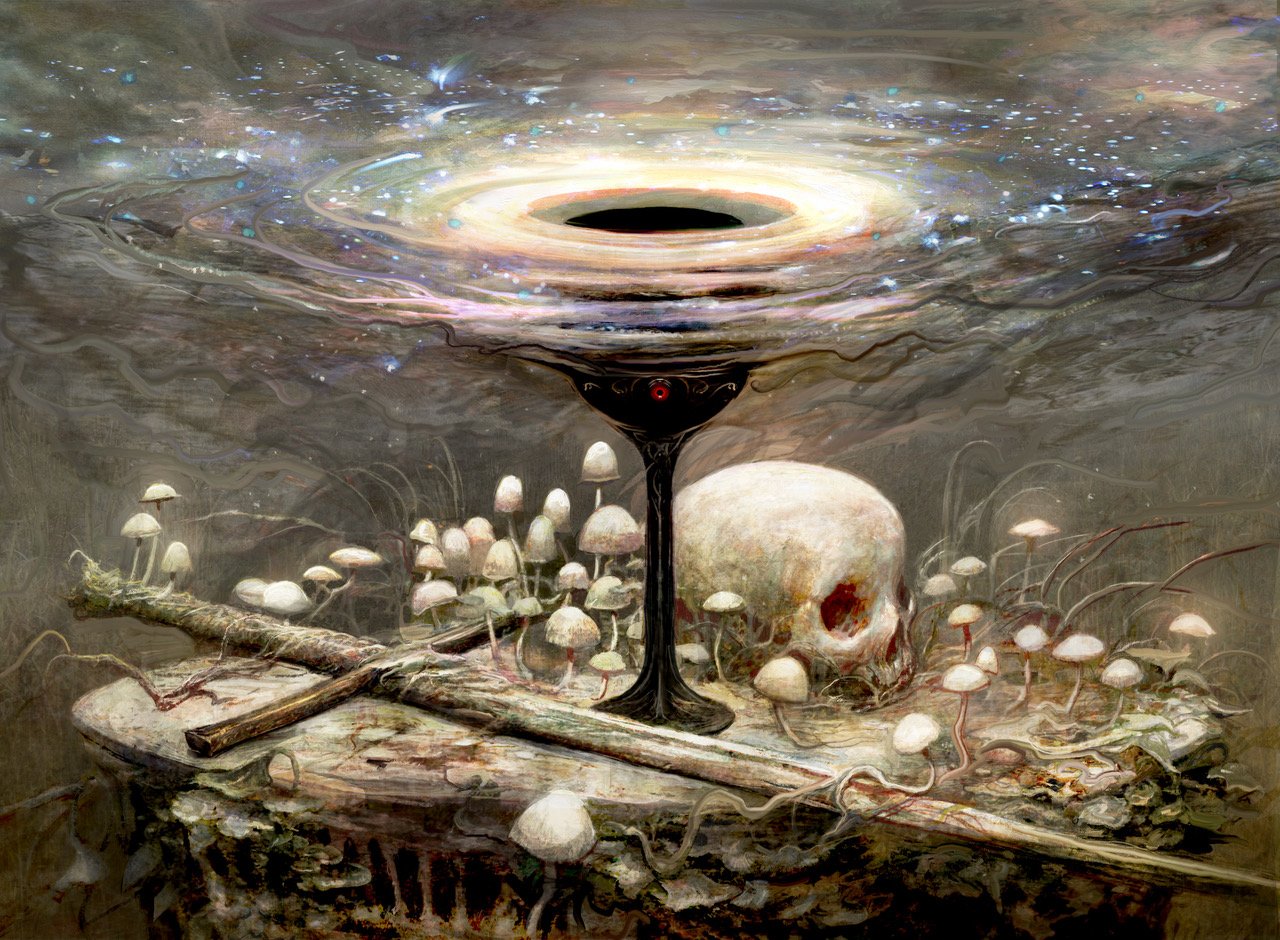
The Chalice is a receptacle of infinite volume. It cannot be filled nor stuffed with solids, rebelling against its master at every opportunity. Whatever is forced into the chalice bleeds through the bottom, in some cases literally, as compressed material will be transmuted into blood. Submerging the Chalice results in the slow drainage of that fluid, should something prevent it from resurfacing. 

Lakshman Anil Paschim would abandon the Chalice in his lifetime.

Location of the Cup:

  1. At the bottom of an evidence locker in the same town that it was found. Who would want this hunk of junk?
  2. Currently in the possession of gentle-brigand Sabir Al-Fahd, a hallwani extortionist.
  3. Being worshiped by a cult of blaspheming Druids. They are using its transformative properties to aid in ritual sacrifice.
  4. Trapped beneath the decks of the Aspis—buried in treasure or on display.
  5. Stuck in a chest at the bottom of a lake, inside of a now-waterlogged ship. The chest has begun to leak.
  6. Jammed inside the throat of a Were-Tiger, fighting to survive in its animal form. The Chalice's trickle keeps them alive—so long as they remain shapeshifted, it won't expand their throat and kill them.
     
    https://pbs.twimg.com/media/Dne2UXHX0AEZbzw?format=jpg&name=large
    Cups Don't Hold Much Religious Symbolism In Séraphine. Typical, Silly Paschim.
    "Chalice of the Void" by Seb McKinnon
Hel's Spear The Spire

Names: The Dominant, Death's Head, Cock of Hades

Who Made You?: Nobody; you sprung from the earth.

Wicked Sins: Blasphemy, Intrusion

-----

 Among certain sects, there is a belief that when the end-times come, every facet of the empire will be utilized in Authority's battle against the forces of evil, including the very cities themselves. Consequently, spires have become a prominent architectural feature, with fleches of silver or gold becoming a common sight across the empire. Spires can be found atop institutions and places of worship, or adorning the walls of fortresses in evenly-spaced clusters. They are, in essence, weapons: tools built to-scale with THEE's might, carved out and occupied for our own convenience.

 Lakshman Anil Paschim saw spires everywhere, for his birth had granted him the luxury of witnessing their many forms. He knew well what their presence represented, and as such, his halls were appropriately decorateddonations strategically applied. Yet Paschim cared little for this particular dogma. These payments were expected of him, a formality rather than a commitment, for what other purpose could they serve? 

    "Say war did come to the Seraphi: would sulṭah truly trash its own kingdom in order to defend us? If so, then would we fill the spires with our institutions? Are we ignorant, or merely stupid?"

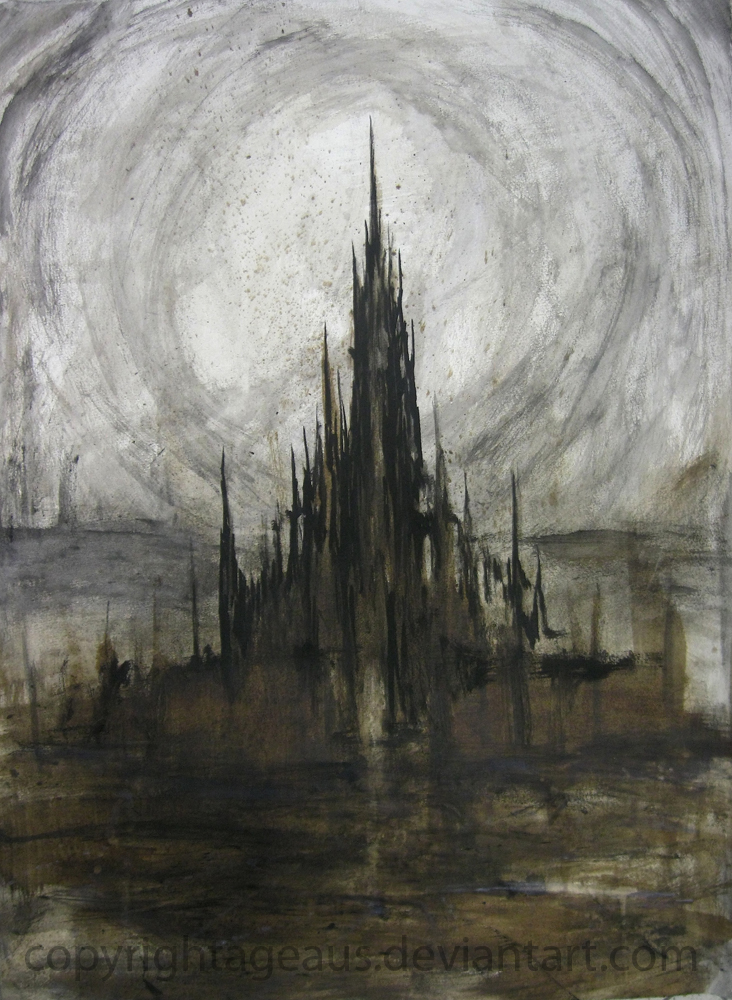
This opinion was not unique to Paschim, nor did it matter. When 200 meters of silt and blackstone burst from the bottom of a once-innocuous lake, threatening to pierce the heavens, all eyes fell on the only man who could be deemed responsible. While other heresies merely threatened his reputation, The Spire revealed to old Paschim threats to his lifethreats which were very, very real. 

Who cares if he had anything to do with it?
https://images-wixmp-ed30a86b8c4ca887773594c2.wixmp.com/f/e40d91f8-de4e-4104-8b3e-84c209930c6b/d6pqw1g-9895ffff-b351-47ce-909b-d125d02ad5b6.jpg?token=eyJ0eXAiOiJKV1QiLCJhbGciOiJIUzI1NiJ9.eyJzdWIiOiJ1cm46YXBwOjdlMGQxODg5ODIyNjQzNzNhNWYwZDQxNWVhMGQyNmUwIiwiaXNzIjoidXJuOmFwcDo3ZTBkMTg4OTgyMjY0MzczYTVmMGQ0MTVlYTBkMjZlMCIsIm9iaiI6W1t7InBhdGgiOiJcL2ZcL2U0MGQ5MWY4LWRlNGUtNDEwNC04YjNlLTg0YzIwOTkzMGM2YlwvZDZwcXcxZy05ODk1ZmZmZi1iMzUxLTQ3Y2UtOTA5Yi1kMTI1ZDAyYWQ1YjYuanBnIn1dXSwiYXVkIjpbInVybjpzZXJ2aWNlOmZpbGUuZG93bmxvYWQiXX0.TauEUh_aN2_TyFTljNMsOu8B-ERv6T3NtVaCstypnqk
It Is Surprisingly Hard To Find Artwork Of Black Spires Sprouting From Water.
"Archaic Sanctum" by Ageus


Features of the Spire:

  1. Creatures of all sorts have ventured into the region surrounding the Spire, making it their home—this includes Devils, heretics, and a multitude of monsters.
  2. There are entrances into the Spire, although reaching them has proven somewhat difficult, due to being so far above the surface. Hope you brought your climbing gear.
  3. The landscape becomes prickly as one travels closer to the base of the Spire, a mixture of upturned crust and blackstone spikes. Likewise, its surface softens during the ascent, smoothing to a point at its apex.
  4. Being a relatively new landmark, the empire has poured considerable resources into its investigation of the Spire and its birthplace. Pathfinders work alongside clerics in their search for an origin.
  5. There is a second building rising from the lake, a lopsided tower of halls and columns which has already partially engulfed the Spire.
  6. Somewhere within the Spire is a second entrance, connecting to a smaller, inner core. 

Looking down the Initiation well.
Imagine This, But Stretched Out & Surrounding The Spire.
Quinta da Regaleira from Wikimedia Commons

Monday, November 7, 2022

Making Cultures, Not Races

What Becomes Of Forgotten Knowledge?
'All Seeing' by Hector Mansilla

Culture is weird. 

I find it very hard to quantify cultural beliefs. That may be because it is flat-out impossible to boil down a complex system such as this to its foundational elements, which I don't necessarily believe, but it definitely proves challenging to imitate. The general sectioning of ideas that we call "culture" is so incredibly complex, so full of hypervariation, that even an amateur artist can handle what is effectively a bottomless chest of creativity. That difficulty seems to lie not in the department of numbers but in words. How does one form a culture? How does it come about in a way that is believable and not born from the seams of mockery?

If you do not intend to humiliate a group, 8 times out of 10, it will not be portrayed as such. I think that (far more often than some may believe) it is possible to tell whether a person is genuinely portraying a group as "bad" or "lesser" or if they are merely representing it. I also believe that you can describe a culture unfavourably even if it was not your intention, so definitely something to be aware of.

However, especially in fiction, sometimes the issue coalesces not in the portrayal of already-existent negativity but in the portrayal of culture as more than what it is. Culture is many things; it is representative of an individual's ideals, codifies a multitude of traits or features into identifiable groups, and can even serve as a microscope into more extraordinary truths. Through culture, we can identify ourselves within a community and, in turn, recognize what constitutes ourselves. 

If there is one thing that culture is not, it is race.

A Misunderstanding?

It should be stated that by no means is this a rampant issue. As more and more media has been published in film and literature, this odd contextualization of cultures as one big blob has begun to die down. Nevertheless, its presence is still felt, and some of the greatest works of our time have proven guilty of adjudicating its existence. From time to time, fantasy fiction predicates an idea that species persist off of mono-cultures—the elves and dwarves of Lord of The Rings, the Daleks of Doctor Who, and the many races of The Sword Coast in D&D—which inform their behaviour. All dwarves are trudging midgets with large beards who live deep within the earth, and all elves are ethereally beautiful aristocrats, deeply "attuned" with nature (wood elves) or snobbish of its creations (high elves), who wander the woodlands with longbows. 

This is in and of itself not a bad thing. The problem is when these ideas become assumptions of the norm rather than the individual. What comes to mind when you think of an elf? An orc? A human in fantasy fiction? A walking tree? Once these monoliths of culture become synonymous with the thing they symbolize, it becomes challenging to separate them again. Arnold Kemp over at Goblin Punch has a fantastic analysis of this problem here.  

So what can be done? If this issue holds the key to worse problems, how can we solve it? I don't know, not just because I think it still has some value but because I am looking for another solution. In designing cultures, not races, I wish to develop groups which stand against the grain of preconception. 
Of course, I'm bound to stumble and fall on the way down, and there is undoubtedly a fine line where culture and race intersect, but I see value in developing one separately from the other. Like faith, lore, and ideals, these totems can be set independently of one another, serving complimentary as a result.

Let's run through an example or two.

Art by Jessie Wu


Same Beginning, Same End

Unless you were grown in a vat or removed through cesarean (salutations, my fellow tumour babies), we were all born the same way. All human beings pop out of a womb after a couple of months, and in much the same way, we all eventually return to the earth. In this sense, we are all the same, but it is beyond this beginning and end that our differences arise. Everything from our genetic makeup to our surroundings to our cultural background differentiates us. 

In a group of a hundred people, the chance that two people share a birthday is nearly 100% (some argue that you can get >50% with as few as 23!). Imagine the fact that you share a birthday with somebody may just be the only similarity you have with them? 

Humanity as a species is ridiculously diverse. Ever since our ancestors scattered across the African continent and spread upon the rest of the world like lice, we've changed in nearly every way imaginable. Think of how many kinds of people there are, and not just in the visual sense? We have conquered entire landscapes—volcanos, canyons and island chains—for no reason other than a desire to live there. How much of your life do you think has been manipulated as a result of your living environment? Ever moved to a place that's nothing like where you grew up? Weird, huh? All aspects of our living experience—immigration examples notwithstanding—serve to teach us how to survive in that environment. Our customs, routines, and social norms act as how-to, informing us exactly how anybody stays in this place, especially the dominant majority. 

What would life be like if we all stuck around? What if humanity managed to construct a babel-esque structure, a leaning tower of pisa for communes, and we just evolved there instead? The issue with mono-cultures is that, in and of itself, the problem of settling, you cannot quell dissidents unless you first dispel free thought. An entire species living in a particular, interconnected location is bound to be made of dozens, if not hundreds, of different interacting groups of people. Sure, you can argue that it's unlikely you'll explore many of these groups in a story (or the author will simply focus only on the dominant majority), but there is absolutely value in depth. 

Ignoring questions of interracial and purely racist consequences, although intriguing and potentially significant, think of how a group can evolve only through their environment? In a tower-city surrounded by desert, how do you come about water? Is emphasis placed on the construction of aqueducts or mines? How does the every-man treat it? Is water a resource (at least somewhat) openly shared, for it is considered a necessity to all, or is it tightly regulated and/or hoarded? How do groups get around the tower, and is such transportation common? Are levels segregated?

Some of these questions may seem purely anecdotal, but they fulfill two objectives: to serve and to inform. What may be seen as "normal" to one faction may be reprehensible to another and openly preached by a third. Culture is not some magical background force that symbolizes the penultimate person; it is an evergreen, constantly changing power, which not only evolves with the group who created it but with the individual it seeds.

There's Lots More To Explore. I'll Be Back.
Art by Pieter Bruegel The Elder


Sunday, August 21, 2022

The Church of Cantankerous Saints

A Quick History Lesson

When the House Constantin's short-lived monarchy finally ended, every sign of their existence was put to the torch. The people of The Republic were a proud conglomerate, always believing in an individual's freedom to live and choose, which made the idea of a "chosen class" incredibly unpopular.

Their tapestries were burned, graves were defiled into mushy crypts, silver and gold melted down into the currency of the new Republic. These were the workings of a nation beginning to heal, yet not all was lost beneath piles of molten crowns. 

The House Constantin believed in a national church with both Gods and Saints. This church was dissolved alongside the royal family, but some remnants were left sputtering with the embers required to grow interesting. The Republic had no need for Gods, but it saw value in the idea that human beings could rise above even material limitations. Thus, The Ex-Saints of Bromeilles were brought to fruition.


Churches are as much an idea as they are a place of worship
Photo from A Lady In London


 Fruition Borne Fruit

The Church of Cantankerous Saints is an organization of self-imposed ex-pats. These citizens have sworn off the trappings of The Republic and its customs, dedicating themselves to the betterment of oneself. Friar-Monks of the church often serve their entire lives within these hovels, searching within themselves for some modicum of truth in understanding the greater picture.

Or at least that's what the official motto says. It seems that most of the time, all they're doing is getting drunk and complaining about the world they only happen to be a part of.

In truth, The Church of Cantankerous Saints serves as a sort of respite for the emotionally damaged in society. A place for tortured souls and the socially adversarial, where they can tend to themselves and others like them and perhaps make sense of the world they left behind. Indeed, many friar monks never leave their monasteries, but this says more about their treatment by society than their own thoughts.

All churches follow a brief code of honour designed to keep new members close and ex-friars humble, most notably:

  1. A visitor is a guest and must be cared for, but can only be brought inside if their life depends on it. Friars must go out of their way beyond the monastery, to a limit, to help those in need. You need not be happy about it.

  2. You must perform some task for the sake of your friary. It may be physical, mental, or psychological, so long as you provide a service to your siblings. You are here to improve, and to improve requires one to learn new tricks.

  3. All members join of their own accord. Once you join the friary, you can never leave; once you leave, you can never return. Remember to pay it back!

 Bad Gone Chaotic Neutral

Nobody is forced to join The Church of The Cantankerous Saints. Some will be pressured, others convinced, and moreso punished by law, but you can never be forced to stay. A foxhole in Corbeaux can drop you into the nearest friary at a whim, but the monks there will very clearly let you leave if persisted. Once escaping becomes an option, what reason is there to stay? Change can only arise if the individual wishes, so The Saints believe, so most newcomers opt to stay.

Once you're in the friary, there's no turning back. From this point onward, you are a new person; you adopt new hobbies and duties alongside worldly changes. Of course, you're allowed to travel outside the friary, whether to perform tasks or barter for the monastery's whole, but only so far. Escape has become a condition with a pre-requisite only attainable through change. 

Whether or not you changed can be argued among your fellow monks, but it is ultimately up to you. Your decision to leave the friary is permanent. It cannot be denied or reversed. 

Former monks of a church are still expected to send back tithe. Paying it back is just as important as paying it forward, and why not support those who did the same to you?

I imagine the churches are all very worn and very old
Picture by Trudy


Weeping Saints

The overall mantra of The Church of Cantankerous Saints shares a similar air to that of the greek philosopher Diogenes, holding tight to his philosophy of critique and cynicism. Life and its core requirements have been muddled over centuries of hobbling, twisted and made complicated, and only through being faithful to one another can these deep social conundrums be solved. 

The teachings of Sainte-Lisabelle de Thibaud are much the same. They call her The Weeper, and her beliefs, too, rallied the causes of cynics and stoics alike. Symbols of her likeness are in most monasteries, sometimes unaffiliated ones, for her kindest lessons teach that life can not always be dark, gruelling and serious. These are lessons taken to heart, especially by the likes of the friars themselves. 

Many of the friar monks are criminals. Convicts and outlaws, refugees and misunderstood artistes, besides all manner of forgotten folk. The lifestyle many of these people left behind often already granted them a more brusque view of the world. The philosophy of The Cantankerous Saints only elevates that.

Being a member of the monastery is both physical and philosophical. A task both social and psychological. It is a place of challenging not only your own world views but the views of those around you, at certain times radically. Rosters here are less cleanly trimmed than in other organizations, meaning that all manner of individuals will eventually pop up within its walls. If you possess no desire to lose your beliefs, perhaps under a preconception that you are somehow more correct than they are, you will begin to study. You will begin to understand from studying, and from understanding, you will begin to teach. This is what schools of thought are made from and, ultimately, where societies are born.

The friars are still human, though. They quip, and they lie, and they fight. They make mistakes and they apologize after a sleepless night of passion. In their words, that is half the reason it is so effective; When the institutions are pulled back, and the strings of the machine are left bare, isn't it so much easier to learn and to fight and to love? They struggle, but they do not suffer.

In simpler words; no bullshit, no problems. 

Tuesday, May 10, 2022

A Thought On Towns

Not every coliseum has to be an Italian one.

Home Is Where The Thought Is


There are lots of towns out there. Towns are the perfect subsidiary to a big city. They are present because a small group of people decided they wanted to be there, formed a working society around it, and then made it accessible to strangers. Villages are a bit different, but this isn't about villages. Villages tolerate tourists, towns thrive off of them.

A town exists because it has unearthed its niche. That niche could very well be a specific export, or perhaps it involves whatever strange happenings occur in the town square at night, but it is a niche so long as it is unique. Cities have no need for such a thing. Their quota has already been filled by the sheer variety of its inhabitants.

A niche does not have to be a thing. It can be a thing, but the presence of that thing is not required for the niche itself to be effective. Villages and towns have sustained off the knowledge alone that, hundreds of years ago, their mountains were once swathed in gold. Those places are cities now.

A niche can be an idea. A thought. A social conduit. One village may enforce its curfew with vicious intent, whilst their neighbour allows even children to roam in the dark. Despite being mere miles apart, the idea is dissociated. 

In this way, towns become a projection of their citizens, rather than their citizens an infection of the town.

Note: I think now would be a good time, if possible, to take a gander at the concepts introduced in Italo Calvino's Invisible Cities. This is the first time I've referenced this work here, but it will probably not be the last. Fascinating stuff.

The Cracked Wall


Nestled between a mountain range and what now comprises The River Gap, the hill-town of Jacquet bustles with the sounds of life and commerce. It is an isolated space, despite its quaint strategic location and the abundance of its resources, leading to a largely negligent relationship with their suzerain: The Republic.

Jacquet is a fighting town. There is not a singular locale nor person you could find in this place that does not show signs of wear.

Street signs are adorned in gashes and indents. Pathways are flat scars of dirt. Every conceivable corner possesses a faded, red blotch somewhere on their flushed face.

The walls surrounding the city have all but collapsed, serving more as an obstacle than a defensive structure for the last 100 years. This also means that the walls are suitable replacements for tunnels, with expert criminals or fencers adorning its sandy carcass.

Even the hint of livestock is shunned if it does not abide by this code. Cock fights are popular for this reason, second only to Baryul (large, moose-like creatures with malleable horns).

Everyone in Jacquet wears their scars with pride. A woundless body invokes the likes of outsiders. Or cowards.


The Broken Pail


Every town has an idol, too. A place or object which provides a unique service to its patrons. It could be a church, or a courthouse, or even a giant nickel. What matters is the precedent:

This thing is ethical to the town's continued existence.

Here, it is the Jacque-de-Lune Coliseum.

These would be helpful if my setting had a visible sun.

Having been built a mere 46 years post-storm, the Jacque-de-Lune is by far the oldest structure in Jacquet, having outlasted even the stone walls which once encased the town. The town's history is ripe with tales of its construction; struggling to build the massive, alabaster arena and its ceiling.

These struggles are tales of pride, of course. Hardship such as this requires celebration!

This is why every week the stadium is packed with peasants and soldiers, merchants and masons, as well as anyone who isn't just sick or dying. Although even the dying would come, if not just to feel the thrill. When the coliseum is at maximum capacity (which it almost always is), each and every not-threateningly busy citizen is present to witness the carnage, with some extra seats to spare for visitors. It isn't uncommon for townsfolk to join in the festivities themselves. Settlings bets or proving your abilities is an ever so slightly admirable cause in front of a crowd, isn't it?

But the champion of the arena is not a native of this town. It isn't even a man at all.