Showing posts with label Seraphine. Show all posts

Monday, July 8, 2024

The Eight Heresies Of Pashem

Lakshman Anil Paschim had a problem... he was too popular. Born into a family which had gained its wealth during the Green Conquest—wherein precursors to the new faith sought recourse for THEE's intrusion, and were promptly crushed—Paschim inherited a taste for affluence. Enrolled in the greatest schools, spoilt by the finest of delicacies, the young boy grew quickly into the shape of a well-spoken & influential aristocrat. 

He was also a brat. How could he not be, as an entitled profiteer? 

But there was one line that Paschim could never cross. For all his outbursts and shows of force, for all of the wealth he possessed and attention he craved, Paschim always refused to outright cheek the church. Heresy was a grave sin, after all, punishable in all ways socially and by rule of law. That which was shared, preached, and made were all protected under divine reasoning: that works of THEE's church were in celebration of the Authority's laws. For all his insolence, Lakshman would never dare commit apostasy against his nation's living God... until he did.

Now they are accursed things. Profane artifacts; mockeries born of a sinful mind.

Here are three. Learn their names, understand their histories, so that you may begin to understand why it is that Paschim was never buried within his own catacombs.

Aspis — The Ship

Names: Kolona, The (Stealing) Ship, She Who Glistens

Who Made You?: A crew of 600 laborers.

Wicked Sins: Blasphemy, Piracy, Unsanctioned Geometry

-----
The Kolona was a Mesquitan prize vessel, commissioned by the Church of the Authority amidst the changing of the royal retinue. Built for show, the Kolona was worked upon by some of the finest craftspeople in the archipelagos, resulting in a trireme of incredible size: fine gems and metals inlaid across its hull, its nose adorned with the face of their ruler Lord Aphotritchides. It was a point of pride for the workers, not to mention a boast of the church's influence.
 
Unpredictable at the time, however, was Anil Paschim's growing attraction towards it.

Shortly before the Kolona took sail, Paschim organized a workforce for the construction of a new vessel, having received "divine inspiration" from the Church's masterpiece. What followed took Paschim's crew months to the Church's year-and-a-half, maintaining a crew of over 600 engineers, manual laborers, and artisans. Their end result was noticeably smaller than the Kolona—about 1/3rd—but nonetheless impressive. Less impressive was the Church's reaction to the vessel, accusing Paschim of blasphemy through imitation. He denied any such intention, deflected the blame, and largely avoided any consequences.

The Aspis was ultimately left unfinished—fearful of pursuing inquisitors, what workers remained (not having fled) pushed the ship into the ocean and sailed themselves to safety. Those same sailors are now believed to have taken up a life of piracy: reports tell of a familiar ship haunting the Mesquitan coast, with eyes like stars within its bow. These attacks have grown so troublesome (and common) that the Kolona's reputation has been irreparably damaged. It is currently being decommissioned.

There Are Things Besides Will O' Wisps In The Dark.
"Night Fog" by Johnson Cameraface


Inhabitants of the Aspis:

  1. 1d6 Workers (Maintenance; slacking off; licking their wounds.)
  2. 1d4+1 Raiders (Preparing for a raid; hunting intruders; sleeping.)
  3. 1d4-1 Mesquitan Janissaries (In pursuit of the ship, now trapped within it. Camping; carousing; hunting crew.)
  4. 3d4 Giant Rats (They have little trouble maneuvering throughout the walls of the Aspis. Breeding; feeding; praying.)

Members of the original crew still endure within the Aspis, along with an assortment of welcome or unwanted guests.

Decks of the Aspis:

  1. The Hold — near-darkness in torchlight; the sound of creaking wood and snapping oars; a persistent sense of seasickness, pierced by whispers in the dark.
  2. The Hoard — chests upon chests of treasure, stolen goods from coastal lands; poor to maintain & hardly traversable; a logistical nightmare. How do we get out of here?
  3. The Bar — a cozy lounge, stocked with food and wine; a moment of respite; music plays softly from a slit in the walls; the bar is manned by a greying beard who takes no requests, offering drink and a kindly smile.
  4. The Barracks — chisels and hammers, quivers and bows; a collection of arms made, inherited, and pillaged; an unlikely menagerie.
  5. The Museum — a gallery exhibit; artwork lines the walls, glass cases atop pillars on display; there is a black stain where a portrait should be, its plaque reads "A Girl Found".
  6. The Muse — a false deck; forever dusk upon the world, a sky bereft of stars.
Triremes are not built with cargo in mind, yet this ship contains worlds beneath its hull. Roll a d6 when first entering the Aspis, then record whatever deck you arrive at. Roll again whenever the party exits a floor, either through another hatch or traveling backwards. In order to escape the loop, reach a variant of the first floor you entered, then exit out the way you came.

Paschim's Cup — The Chalice

Names: Chalice of the Covetous, Sorrow, The Great Dissapointment

Who Made You?: a goldsmith's apprentice, imprisoned in a workshop

Wicked Sins: Kidnapping, Obliteration

-----

Lakshman Anil Paschim was not an artist, but he was incredibly envious. More than flaunting his family's wealth, Anil Paschim surrounded himself with artists and their work because they possessed something he lacked—whether mechanical skill or a sense of imagination. Unwilling to pursue an artist's education, Paschim still craved an object for himself...

...And so he studied. Again and again, until the works in his collection had been observed a thousand times. He glared at their construction—sculpture and vessel alike—and tried to ascertain how they came to be. He looked to their sources, sought out their parts, working day and night to reverse-engineer what made them such fine art. When the time came for Paschim to create his first work, the final product was predictably shoddy. Frustration welled inside of him. Following another attempt, then two more, Paschim abandoned his efforts for a far simpler plan.

The Chalice is a receptacle of infinite volume. It cannot be filled nor stuffed with solids, rebelling against its master at every opportunity. Whatever is forced into the chalice bleeds through the bottom, in some cases literally, as compressed material will be transmuted into blood. Submerging the Chalice results in the slow drainage of that fluid, should something prevent it from resurfacing. 

Lakshman Anil Paschim would abandon the Chalice in his lifetime.

Location of the Cup:

  1. At the bottom of an evidence locker in the same town that it was found. Who would want this hunk of junk?
  2. Currently in the possession of gentle-brigand Sabir Al-Fahd, a hallwani extortionist.
  3. Being worshiped by a cult of blaspheming Druids. They are using its transformative properties to aid in ritual sacrifice.
  4. Trapped beneath the decks of the Aspis—buried in treasure or on display.
  5. Stuck in a chest at the bottom of a lake, inside of a now-waterlogged ship. The chest has begun to leak.
  6. Jammed inside the throat of a Were-Tiger, fighting to survive in its animal form. The Chalice's trickle keeps them alive—so long as they remain shapeshifted, it won't expand their throat and kill them.
     
    https://pbs.twimg.com/media/Dne2UXHX0AEZbzw?format=jpg&name=large
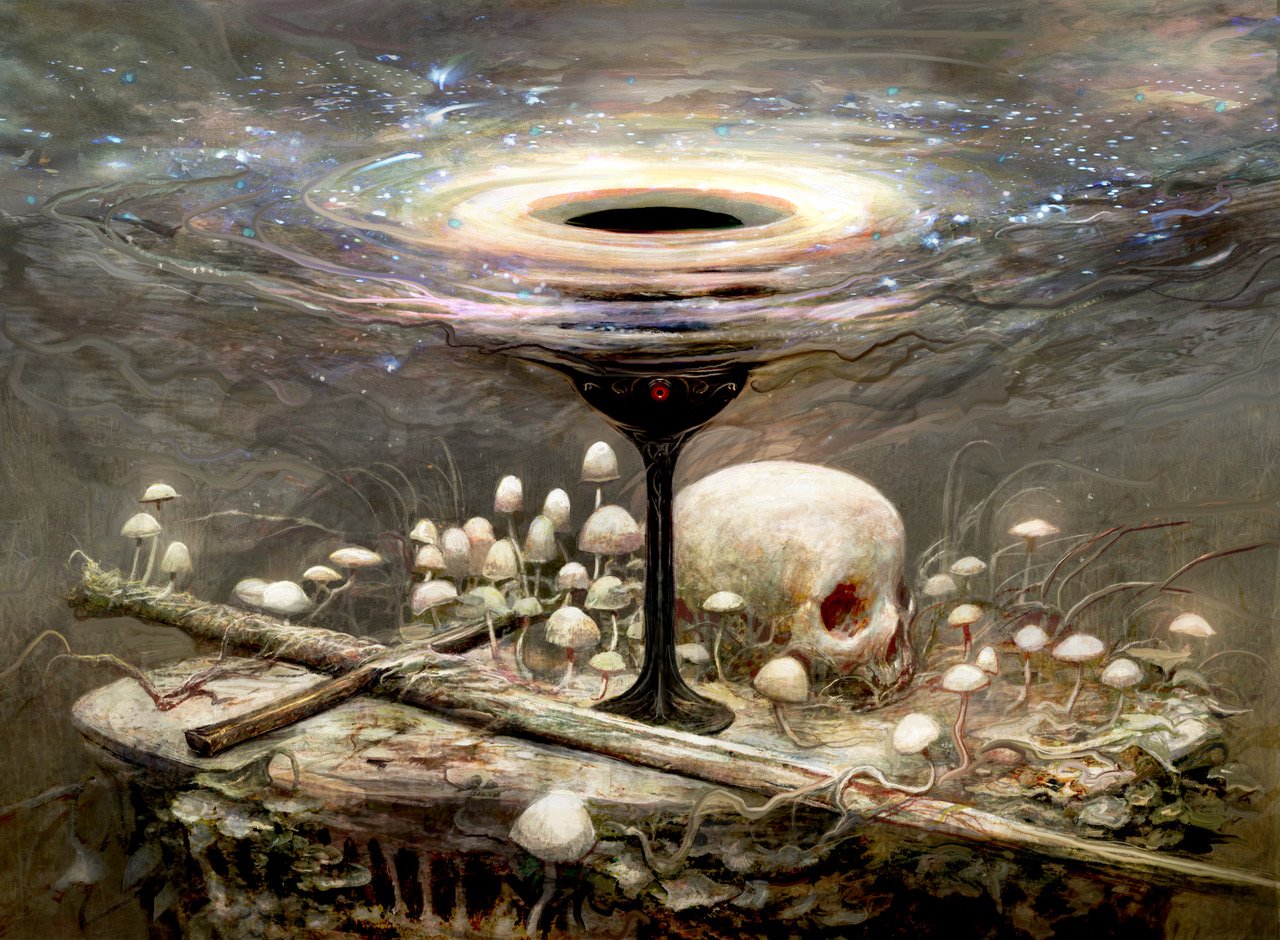
    Cups Don't Hold Much Religious Symbolism In Séraphine. Typical, Silly Paschim.
    "Chalice of the Void" by Seb McKinnon
Hel's Spear — The Spire

Names: The Dominant, Death's Head, Cock of Hades

Who Made You?: Nobody; you sprung from the earth.

Wicked Sins: Blasphemy, Intrusion

-----

 Among certain sects, there is a belief that when the end-times come, every facet of the empire will be utilized in Authority's battle against the forces of evil, including the very cities themselves. Consequently, spires have become a prominent architectural feature, with fleches of silver or gold becoming a common sight across the empire. Spires can be found atop institutions and places of worship, or adorning the walls of fortresses in evenly-spaced clusters. They are, in essence, weapons: tools built to-scale with THEE's might, carved out and occupied for our own convenience.

 Lakshman Anil Paschim saw spires everywhere, for his birth had granted him the luxury of witnessing their many forms. He knew well what their presence represented, and as such, his halls were appropriately decorated—donations strategically applied. Yet Paschim cared little for this particular dogma. These payments were expected of him, a formality rather than a commitment, for what other purpose could they serve? 

    "Say war did come to the Seraphi: would sulṭah truly trash its own kingdom in order to defend us? If so, then would we fill the spires with our institutions? Are we ignorant, or merely stupid?"

This opinion was not unique to Paschim, nor did it matter. When 200 meters of silt and blackstone burst from the bottom of a once-innocuous lake, threatening to pierce the heavens, all eyes fell on the only man who could be deemed responsible. While other heresies merely threatened his reputation, The Spire revealed to old Paschim threats to his life—threats which were very, very real. 

Who cares if he had anything to do with it?
https://images-wixmp-ed30a86b8c4ca887773594c2.wixmp.com/f/e40d91f8-de4e-4104-8b3e-84c209930c6b/d6pqw1g-9895ffff-b351-47ce-909b-d125d02ad5b6.jpg?token=eyJ0eXAiOiJKV1QiLCJhbGciOiJIUzI1NiJ9.eyJzdWIiOiJ1cm46YXBwOjdlMGQxODg5ODIyNjQzNzNhNWYwZDQxNWVhMGQyNmUwIiwiaXNzIjoidXJuOmFwcDo3ZTBkMTg4OTgyMjY0MzczYTVmMGQ0MTVlYTBkMjZlMCIsIm9iaiI6W1t7InBhdGgiOiJcL2ZcL2U0MGQ5MWY4LWRlNGUtNDEwNC04YjNlLTg0YzIwOTkzMGM2YlwvZDZwcXcxZy05ODk1ZmZmZi1iMzUxLTQ3Y2UtOTA5Yi1kMTI1ZDAyYWQ1YjYuanBnIn1dXSwiYXVkIjpbInVybjpzZXJ2aWNlOmZpbGUuZG93bmxvYWQiXX0.TauEUh_aN2_TyFTljNMsOu8B-ERv6T3NtVaCstypnqk
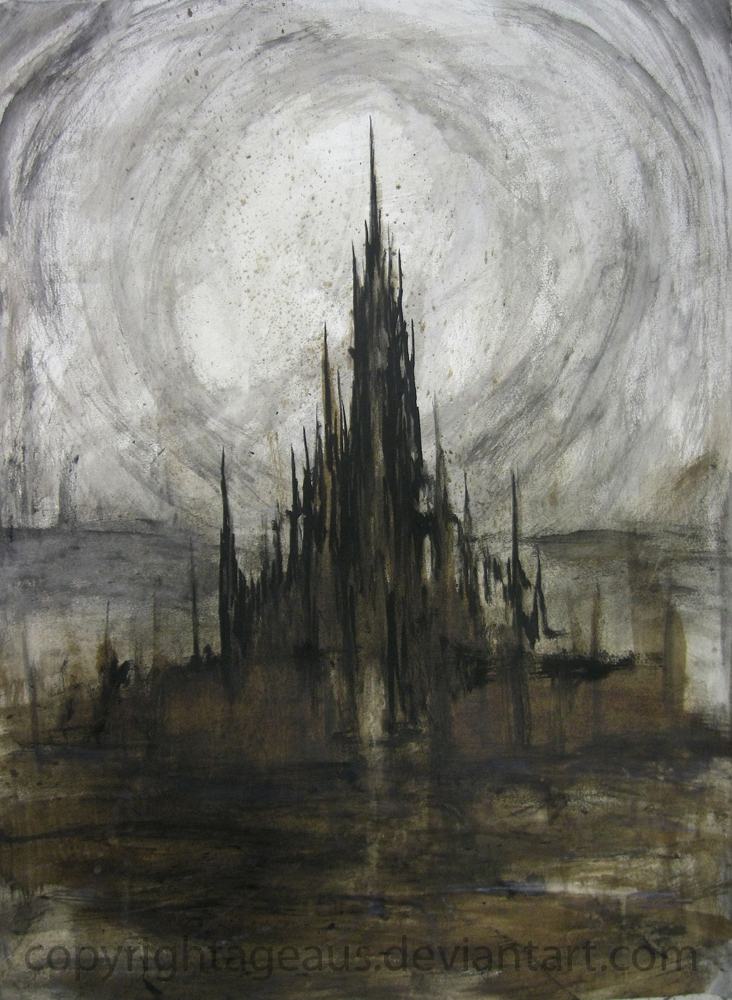
It Is Surprisingly Hard To Find Artwork Of Black Spires Sprouting From Water.
"Archaic Sanctum" by Ageus


Features of the Spire:

  1. Creatures of all sorts have ventured into the region surrounding the Spire, making it their home—this includes Devils, heretics, and a multitude of monsters.
  2. There are entrances into the Spire, although reaching them has proven somewhat difficult, due to being so far above the surface. Hope you brought your climbing gear.
  3. The landscape becomes prickly as one travels closer to the base of the Spire, a mixture of upturned crust and blackstone spikes. Likewise, its surface softens during the ascent, smoothing to a point at its apex.
  4. Being a relatively new landmark, the empire has poured considerable resources into its investigation of the Spire and its birthplace. Pathfinders work alongside clerics in their search for an origin.
  5. There is a second building rising from the lake, a lopsided tower of halls and columns which has already partially engulfed the Spire.
  6. Somewhere within the Spire is a second entrance, connecting to a smaller, inner core. 

Looking down the Initiation well.
Imagine This, But Stretched Out & Surrounding The Spire.
Quinta da Regaleira from Wikimedia Commons

Monday, June 20, 2022

Phobophobia


F3LC4T on Artstation

Mortal beings are complex things; the best way for an alien to understand one is to view them through mortal eyes. What emotions make up the human experience are as unique as they are dangerous.

Pleasure. Passion. Fear. These things make up the genetic makeup of every creature. They mould our understanding of the universe around us into mutable shapes, granting us eyes to places previously misunderstood. You only understand anger because you have experienced anger before. You can empathize with a mother's loss of a child because you've experienced that loss, or at least some vague approximation of it. The death of a loved one. A beloved pet. 

The feeling doesn't have to be exact. It can be close or entirely off the mark. You wouldn't consider the loss of a pet even close to that of a child, but you can draw some conclusions. Both are a kind of grief. Both are debilitating, and yet one is far worse than the other.

Something that is not human could draw that conclusion. It may not understand, but it could try.

Fear in Faith

In Bromeilles, belief is power. Rumours carry genuine danger in their delivery. Wive's tales are more than just stories; their creation can actively spurn violence in the community. This was true long before the trappings of civilization and has only worsened in the wake of The Storm. 

Mankind has always feared its own thoughts. As necessities are met, tensions rise, and more esoteric concerns enter the fray. Once a home has been built, and physiological needs are met, what of improvement? What of one's social standing, achievements, and doubts? The hierarchy of needs states plainly that there is more to fullness than survival. 

This does not have to be a good thing. More requirements are simply more problems to fix. And in a world with so many issues, what harm could one more supplant?

Maslow had a pretty good framework.

La Republique has always known of The Mirages. It was founded with the things in mind; shaded beasts just beyond the vale. Creatures made from nightmares and whispers. Phenomena of the unknowable. When the republic's amendments were finally written, prefaced by a brief struggle for power, handling these mirages became a point of utmost importance. 

Hunting down mirages is a simple task. It is even easier to identify the things, which dwell where children speak to shadows and hunters say of tigers. Resistance arrives when one remembers that, while it is easy to tell someone to avoid a place or stop a slipshod habit, it is far more challenging to order an entire country to stop thinking.

Mirages spawn from mortal misunderstanding. A peasant girl who fears monsters in the woodlands may create one on accident. A child who sacrifices bones to the "well-thing" is curious, yes, but could just as likely conjure something to consume those bones. Once a Mirage has been fed its due diligence, it breaks free from its fear-ridden chains, granting it a sort of freedom it should never be allowed. These are the monsters which devour towns. These are the beasts who take children away.

Not all mirages are malevolent, nor alive. Some have brought good to the people of Bromeilles. Others are active in its continued subsistence. This does not make them any less undesirable.

Faith in Fear

There was no great fanfare when The Authority came to Seraphine, no blowing trumpets or grand parade. It came to the first king in a gust of wind, shapeless yet with booming voice, and ordered its will as it would be. The angels came later, strapped in jointless wings and molten chariots, but it was he who etched the first words on parchment.

The many manuscripts of the angels, conjoined with both the first king's writings and the complete work of The Manual, bring a somewhat complicated canon to the church. What all three of the works agree on, however, is their stance on mortality:

"Mortals are in a state of constant, perpetual suffering. This suffering is their fault, but it is not something they can control. We cannot simply remove this misery from them. Therefore, we shall work with what we have. They will be tormented as a result. We do not blame them, but it must be done."

This uncomfortable truth has led to several revelations in the world, most notably the existence of Devils. The official canon states that devils have always existed in the material plane, influencing mortal lives and inflicting pain upon them. It is their vulnerability to suffering which grants these devils such power. Devils are considered vile, despicable creatures. They are also considered a necessity.

According to church canon, Devils are the natural consequence of mortal will. Their freedom to both emote and inflict harm on one another is a sheer indicator of maliciousness, which these same creatures accept like parasites. By consequence of existing, the people of Seraphine have created vessels containing their worst parts. Beings which hate more than any living thing. Things which hunger to consume more than the world could possibly provide.

This is as expected, and therefore it is right. Angels give no hesitation in slaying the beasts, but it is known by all that they are under no false pretenses; they will continue to exist so long as man does.

Wednesday, June 15, 2022

The Fishing Devil


David Johnson

Makram Al-Tervih was the greatest entertainer to ever live. 

A young talent from the moment of his inception, the gold jester was born to indentured servitude. A result of his father's secret affair with a water peddler. He was stricken in two for the act, but his mother was allowed to carry the young child to term. They were subsequently servants to the man's old house.

A titular munchkin at his emergence, the midwife joked that had he been born any smaller, he could fit into a mail canister. It is said that young Makram smiled with glee at the proposal.

A Golden Child

Born Makram Aben Rahmat after his blood father, it took many years for the young entertainer's talents to be noticed. A self-proclaimed rascal in his youth, the boy's quick wit and arrogance were his grandest defence, keeping him out of far more trouble than he deserved. 

Note: Seraphine is a continent built under extreme predeterminism. When the Authority first came to Aabrya and became acclimated to the building of its church, a set of ground rules were delivered from its molten throne to the growing theocracy below. Such rules, comprised in The Codex of Kings, include a strict code of destiny; Peasants are peasants, and kings are kings. Few gain the privilege of defying this rule. It is always given and infallibly earned.

He was a jester at heart. A boy of laughter and chide, as quick on his feet as he was with his tongue. A menace to all, including his mother, the boy's antics were permitted unfettered so long as he completed his drudge tasks. A chore he performed amicably even long after his departure.

David Lloyd Glover

Under the palm of his new lord's house, Makram performed diligently to age 17. His attitude was jovial in all things, lighthearted even at the darkest times. It was that spark that made him so desirable. Suitors would come in well-packed suits, attempting to marry a poor servant boy their daughters and sons. Time and time again would their advances be brought to the house. In dowry or word, proclamations of love and wedlock. All would be denied with a gallant whump.

Makram had no need for the trappings of love. Prestige and honour were merely a means to greater aspirations. Those without a knack for wit, without patience for jest or laughs, were discarded in his mind instantaneously. For if you could not understand what a man loves most, why bother at all?

A Silver Lord

It took many years for the boy's talents to be noticed. After innumerable letters and heartfelt summons, it seemed as if he would remain forever a joyous servant. His jokes were of little interest to the master of the house, his father's brother, and there was only so much content that could be scrapped from the bottom of his surroundings. 

Makram was content with the knowledge that he would never truly be free. He would have been right had he never met the Lord Aphotritchides.

Son of Fahid, Father of a Million Sons, ruler of the Mesquite for a hundred years. He came for the young entertainer in a letter fashioned from beads of silver and parchment gold. The Old Lord was, at the time, a grand duke of Seraphine's eastern provinces. A ruler of beaches and timberyards, who ripped trees by their roots with great success. A man of limitless coffers, he had a penchant for petitioning artists from all across the land. His hunger for new talent was voracious.

And so, the young entertainer found himself in the company of royals. His talents would only grow with age, and his mind would swim in the pleasures of life.

A Copper Coin

For twenty years, the now-proclaimed Makram Al-Tervih served as crown jester to the duke's throne. His journeys took him across the continent, to country and island, filling his eyes with the many great wonders of the world. His blessings were great; wine, comfort, lovers: for his duty was as crucial to the realm as his master. He was a comedian. A clown of the heart. His words were a source of much-needed joy.

But the boy had a secret. Whisperings of the heart never meant to be heard. Known only by his closest friends and then only truly understood by his mother, he had managed to avoid its woes for decades.

Andreas Achenbach

One day, The Lord Aphotritchides declared yet another hosted celebration, set to the sight of his most prestigious villa. It was a grandiose occasion for a monstrously large locale, his favourite summer home atop the rocky shelves of the coast. Its cliffs crumbled into the waves below.

Even as the festivities began, the duke could see his jester's essence flush. Eyes chattering in their sockets, sweat rolling down his arms and into the baggy pockets of his leggings. Indeed this was not his first celebration, so what was the fuss? His grin was wide as he called those in assembly to attention.

"As a means of goodwill and pleasant feasts," he spoke, tongue flippant with liquor, "I ask that my most trusted confidant perform his greatest feat yet!"

The jester's heart sank beneath his bowels. Several servants began to unravel the final festivity: a massive stage atop the cliff's edge. Its foundations crumbled rock as they were nailed to the earth.

"My golden child shall complete a daring performance atop the blessed cliffs of my home! His rushing blood shall liven this land. His sweat will purify the surf below!"

"May his composure in the face of death bless our nation for years to come!"

Edward Potthast

Makram Al-Tervih was scared of the sea. It had terrified him since he was a child, its inky depths as mysterious as the endless cosmos above. He had written entire plays on the folly of man in war. Love, science, and the great forever above were topics he took great joy in dismantling, but never the ocean. He avoided the subject as if his attempts would offend it. His gaze avoided its as if some great catastrophe was set to strike, would they have met.

He lasted thirty minutes. Half an hour of constant, incessant dancing and performing. Not a word slipped from his lips, even as he tumbled between brass rings and burning spears, and yet the crowd still roared with applause. Makram could be funny as a mute or an amputee, but never to the sea. He finally met his end, catching his foot beneath a copper plate, snapping the support and sending them plunging into the waves below.

It is said that he cried as he plummeted. It was a long drop, ten seconds before the rocks or the water took him. Plenty of time for the terrified trickster's mind to conjure up some final words. The rumours say that he spoke of fear and devils, of heresies unheard of by his tongue, just before his lips touched the water. A servant whispers that the waves broke as he approached, and that his body flattened against the seabed dry as a stone.


Of Consequence

The Old Lord never returned to that palace. His guests were ushered outwards, and the gates locked behind them. Its location was stricken from all the world maps, and its serfs cut at the tongue. It is muttered that he never spoke of what occurred that day. Many post-mortem accounts proclaim that it caused a profound change in him. The Lord Aphotritchides would live another six years after this event, completing his centennial service and allowing his body to rest.

Makram Al-Tervih is remembered as a man of great talent, who gave his life in worship to the Authority and its teachings. Lessons are taught from his works in universities, and statues are erected in his honour. But it is the sailors who speak most highly of him. Those who ride the eastern cliff walls speak blessings to his soul and cast gifts in his name, seeking protection from the man who missed the tide.

The fishermen curse his name inland and speak of him nowhere else. They believe that his spirit roams the ocean still, a pocket husk burrowing beneath the ocean. They would be partially mistaken.