Showing posts with label Imps. Show all posts

Saturday, July 16, 2022

An Introduction to Magic In Bromeilles

Magic is an open book, capable of being read by anyone. There are no chosen ones, no genetic gatekeepers of the mystic arts, and although those in positions of power would have you believe otherwise, even the lowliest serf is capable of lifting up a wand and disintegrating their oppressor. The problem lies not in the availability of magic, but in the threats that bubble beyond its surface.

All magic, inherently, is a manipulation of the free forces of the world. It is an act of vicious realignment with one's wishes, with varying levels of ferocity. The primal touch of the Druids is considered the kindest by far.

This violent grasping of the universe is incredibly dangerous, as one might expect, and has taken the lives of thousands who believed that they knew better. They did not. This is why The Twelve Laws were put in place, and every Artisanal School on the continent keeps at least one Lolea on hand; executioners, lest a mage falls too far from grace.


The Occult

Artisanal dictum states that all magic is transmutation. It is the shaping of the molecular building blocks of reality, and all the dangers that they provide. Evocation is the transfer of heat and other energies into malleable states. Conjuration is the formation of pseudo-real things, made from 'sleeping' particles, which inevitably awaken and destroy the projection. Illusion is just the manipulation of the shadows of molecules, like puppets strewn by candlelight.

Every school of magic fits somewhere in this mystical cosmology. The school of transmutation itself is no exception.

The Republic adopted magic into their foundation shortly after The Storm Eternal, seeking resolutions to problems which had never been solved before.

Roberto Gatto

Some would tell you that the late Gisele De Roy introduced the Occult to The Republic. This would be a lie. While the philosopher devoted his life to studying the mystic arts, the imps welcomed mankind to this specific breed of magic. They called it a gift: an opportunity for The Republic to construct and rebuild beyond its potential. Several hives killed communication entirely once they realized the horrors mankind had uncovered with it.


Form & Function

All practitioners of the Occult Artform understand the two primary components necessary for casting: Conduits & Catalysts.

Conduits are things in the physical world that act as transmitters of magic into existence, whether objects or creatures. A machine roars, a wand crackles and snaps, and a fingertip glows with light. From these things, the tedious process is finalized and law is transformed into chaos.

Catalysts, by process, serve as fuel to a conduit's commands. The Twelve Laws dictate that matter cannot be created or destroyed, only transmuted into other states. As a result, Artisans must rely on that which encompasses the world itself to create magical effects. This is where most fledgling wizards first learn the harsh consequences of their craft.


Digression: Wizards and other legal practitioners of the Occult in Bromeilles are known as Artisans, and their schools are known as Artforms. They have become a guild of sorts in the social hierarchy of The Republic, and have been granted privileged positions as a result. Artisans are, however, also legally considered a permanent detachment of the military. All who enroll in Artisanal Schools are under strict obligation to the state. Opinions on this policy are mixed.

Anything can be made into a catalyst. Many of the specialized techniques taught at the Artisanal Schools utilize the same components for ease of access. Still, the theoretical limit to what could be used for nearly any spell is close to limitless. Mushrooms wilt and die in one's palms as electricity purrs from their hands. A ball of yarn unravels and pounces at its prey. Teeth shatter in their owner's mouth in a last-ditch effort to survive.


Subschools

All magic refuses to categorize itself by the inherent will of being chaos. It was imps who first began studying the art, but it was Man who pinned hundreds of names and terminologies in an otherwise empty cushion. The concepts of Conjuration, Abjuration, Illusion and Enchantment are mortal concepts, and would otherwise cease to exist in a lifeless world. But it can (and does) appear without intervention in day-to-day life, which only drives Archivists farther down the rabbit hole of madness.

To date, there are thirteen officially recognized Artforms of "significant" occult magic in The Republic; eight of them primary and the other five secondary, along with dozens of smaller, esoteric schools of thought. Many artisans go their entire lives without learning a single technique from half the available forms.

Subschools are subschools not just because of their obtuse rarity and unpredictability, but just how unorthodox they are from the other artforms. It is possible to uncover several overlapping conditions between two primary schools without manipulation. This often leads to only more overlap. The primary artforms are bound together in ways barely comprehensible by the average mind, yet the subschools lie entirely outside this fence. In another world, some of these artforms would be considered primary schools entirely on their own.

A particular artform is often specialized at an Artsininal school, and many Artisans pick other primary schools to serve as their minors. Subschools are almost exclusively learned from a particular location or area of teaching. Hemomancy is almost exclusively taught to Cruorwrought, Ferromancy to witches and hedge knights.

Monday, May 16, 2022

Sand Moles

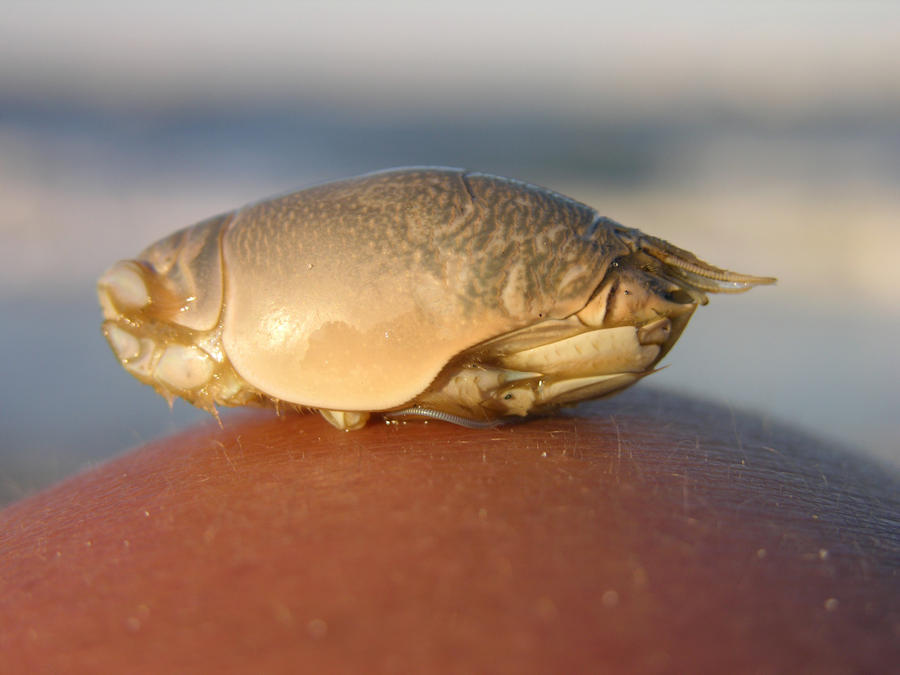
The deûlémain know them as dire moles, but most of the world calls them emeridae. They live amongst most of the beaches on the cracked continent and are a piecemeal menace to its inhabitants.

Emeridae are distantly related to giant crabs, lacking their cousins' pincers or widened stance in exchange for a hard, barrel-shaped carapace. Their limbs are long, hooked appendages which lock loosely into position underneath their bodies, allowing them to glide effortlessly across rushing sand or tides. An emeridae's eyes consist of a half-dozen black sprouts. A bundle rests on each side of the head, which projects through a thin hole bored on each flank. This peeking only occurs when submerged, preferring to otherwise keep their antennae safely within their shells.

An emeridae possesses twenty-two limbs of various sizes, most of which are specialized in digging through soft sediments. Using several shoehorn-like tools at the ends of their stems, they're capable of scooping considerable amounts of material from underneath. This allows entire packs to drop below the beach floor in just a second. They are slow creatures (no quicker than a moderately excited pig), but their movement potential increases exponentially once below ground.

Emeridae are Imps. There are many different kinds of imp — the majority of which being non-aware subspecies — that exist in discordant harmony throughout the realms. Many subspecies become cattle stock or mounts for various organizations, while others remain suitable as labourers within imp colonies. Imps have a word to distinguish these labour-beasts from other impkin ('Svnth' like Synth), a distinction most other cultures lack.


An average female grows between 0.9m and 2.0m (3 to 6.5 feet) in length, with males maturing somewhere just shy of their mates. Emeridae gather in packs, with egg-bearing mothers at the peak of its hierarchy. Emeridae give birth to clutches of bright, baseball-sized orange eggs, which they hold tightly against the undersides of their body. These eggs are brittle to the touch like hydrogel balls and a coveted ingredient in stews. They are violently protective of these clutches.

They are conscious but not intelligent. Imps possess a limited line of communication with them, which boils down to a limited form of speak with animals. Negotiating with an emeridae often revolves around the basic understanding of "leave us alone, and we'll leave you alone." They have no need for treasure but collect it in troves, both for clueless bedding and as a ribbon to bargain with. Emeridae dens lie several feet beneath the beach floor, massive dugout rooms held wide by whatever trash or treasure they manage to scavenge from adventurers. 

Emeridae Den Loot

1. A dead adventurer (50% still wearing their equipment).
2. 350sp in various coinage.
3. A half-eaten giant tuna.
4. A mage's lost robes.
5. Forgotten crates from a shipwreck.
6. A dead emeridae (25% of being female, holding eggs).

Round.

Don't mess with a mother and her children.

An emeridae has no concerns for the nature of its surroundings. All it wishes to do is live beneath its rocky beaches or sandy shores, utterly free of interruption, until the day its eggs hatch and it dies. They do not go out of their way to fight trespassers, often too busy hunting fish from the sands beneath the deep tide. This does not make them ambivalent. Those in a pack who are not spent hunting or digging their burrows will violently undermine those who step atop their grounds. Hunters of the emeridae's shells or eggs will oft find themselves sucked beneath the beach by the imp's talons. What limbs aren't tipped in scooping horns are adorned in frills and spikes.

The imps can clamber to the topmost layer of sediment, grab a fully-grown man with their claws, and then fall back beneath the sands in just over a second. They move through sand like water, grasp flesh like velcro. They do not consume human flesh, but their corpses still litter the burrows.

Beyond their own flesh and eggs, emeridae are considered valuable for their carapace, which possesses impressive durability while maintaining buoyancy. Witches will occasionally travel to beach burrows to dig for eggs, then used for alchemical purposes or bred as pets. A domestic emeridae provides an excellent familiar, serving as guard and breeding stock.

Emeridae can "coast" with the ocean tides, digging up to the surface whenever the waves wash or recede. This natural movement allows entire colonies to scurry from point to point. Sailors watch for Emeridae movements, tracking their round bodies flying down the beach as a sign of nearby fishing grounds. Imagine this but faster, larger, and with a lot more barbs.


Wednesday, May 11, 2022

Meet: Skullcrusher

This is part two. Click here for part one.

Conflict is a way of life in Jacquet. Every man, woman, or child has had some sort of fight to rationalize in their daily lives. Someone hasn't had their thorn bushes flower in weeks. Others have a debt to pay with loan sharks or neighbours. Nobody has a peaceful, boring life in Jacquet because peace implies you aren't doing anything with it.

And so, every week, the coliseum fills for the bloody festivities. Mostly gladiatorial events or brawls between beasts (a shmuck fighting a bear is typically seen as pretty one-sided for the bear and therefore boring). Sometimes a particularly rowdy gentleman will sign themselves up to settle an old rivalry. Fistfights over unpaid debts are frequent.

Everybody makes a little bit of coin on fight day. Gambling is encouraged, if not expected, pastime. Many opportunists have taken advantage of the events by setting up "betting tables" for the day, only to close shop when the fight ends. Sometimes this occurs before the winners get their payout. This does not end well for them.

Whenever the fights begin, the crowd roars. Distant birds scatter at the sound of wailing hordes. It is a momentous occasion. Absolving. It is a cleansing of shame. Of virulence. A prize to be won. 

But there is an expected result when the day is over, and the coin is counted. Every visitor knows to leave a crown in the small, leathery basket just by the door. Nobody knows who put the basket there, only that it is something you must do.

Because this patronage is reserved for the star.

A Challenger Approaches


The result is the same every week. 

The crowd pours in, filling their seats with fervent anticipation. Any betting that was set to begin had already started behind the gate. Merchants and soldiers pour in from near and close, far and wide, to experience the festivities.

Children play with twigs and stones. Seniors recall tales of yore to their neighbours by pointing out the various scars across their bodies. There is always a flowery scent in the air. Pleasure, food, death, and fear are palpable tastes in the coliseum.

They all see the bump. That obsidian mound furled up atop the arena's sands. 

It is an object paid no mind. It would be unthinkable to attend to a thing so ordinary, so dull to this town's residents, like the ornamental fountain in a town square. The crowd bubbles forth from their homes and their tunnels into the bleachers, awaiting the games to begin, and they wait. A stunted cough or jeer snubs out the perpetual anticipation of the crowd. At once, the seats are finally filled, the gates are swung shut, and the festivities can truly begin. That is when the main event presents itself.

Meet Skullcrusher. The Crown of Mètin.

Buff Bug.


The Main Event


Nobody knows where The Crown came from, having arrived one day from the outskirts of town, a herculean force of chitin and muscle. He had no name, influence, or money to spend. He did not speak to any shopkeepers or merchants, nor did he care for the bickering in the streets and bumbling rush of patrons. Any threats to his appearance or plum-faced young men were ignored. All he did was walk. Into town. Into the markets. Into the square. It had only been finished a decade by the time he reached the Coliseum, young sculptors still scrubbing mortar off its walls.

The bug had marched across its still-glistening floors, pushed through its freshly wrought gates, and beamed. As if they welcomed a champion who had already proven their worth. Nobody had seen this imp before, never one of its size. Its appearance was that of dread. Finally, it had reached the centre of the coliseum's sandy pits, and once it had scanned the land around it, it paused. The not-yet-named Crusher of Skulls tilted its horn to the air, blew air from its face, and collapsed to the floor. Snug and sound crumpled together with his horn to his knees. Some believe that he had come here to die. Others that he was punished: struck away from some terrible deed. The hopeful in Jacquet feels he has merely come for a good fight.

 Whatever reason it may be, he has remained since. Having shown no signs of stopping.

(note: Skullcrusher is an Imp; basically a bug-like humanoid in my setting. There are many kinds of Imps and many more subspecies of imp-like creatures, but that is something to develop in another post. Just know that Skullcrusher is a very large but not entirely out-of-the-ordinary imp. He isn't necessarily weird because he is a bug, but because he's an odd bug.)
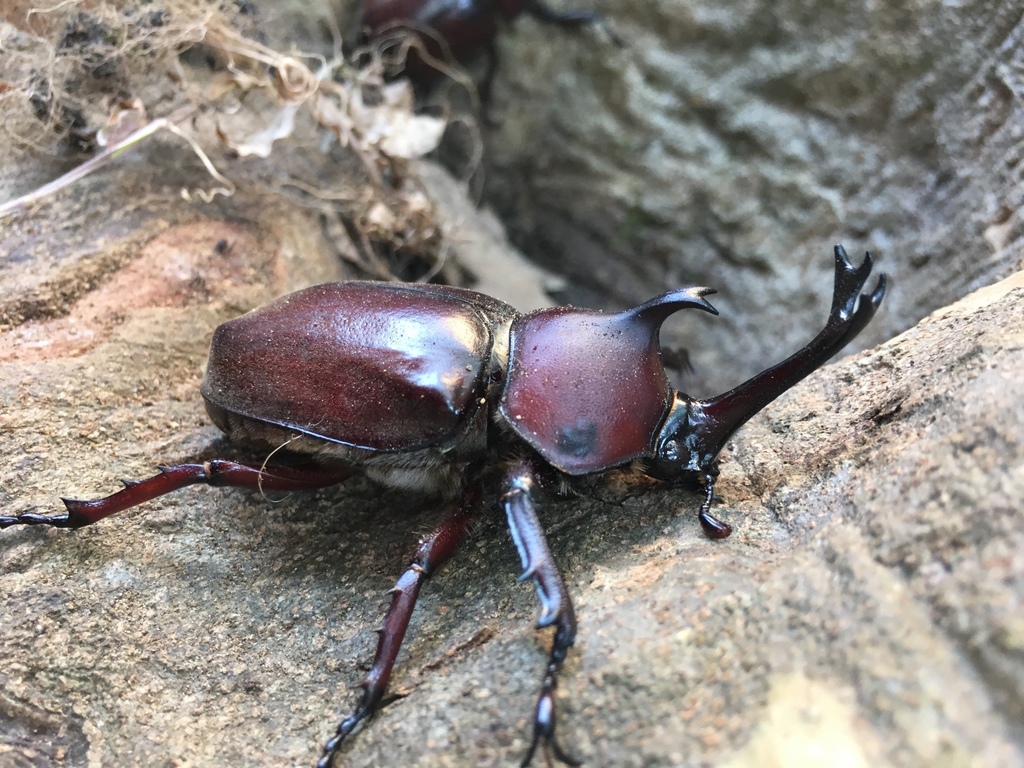

Imagine a 9' tall, buff humanoid bug, except the red colour on their chitin wasn't always there.

Skullcrusher does not do much. The bug refuses to speak and doesn't appear to understand the common tongue (and if he did, he hasn't shown any evidence of it yet). Communication through another imp seems to bring a mild sense of understanding, although it isn't much. Imps can communicate non-verbally through a series of chemical processes, producing whatever respective pheromone messages they desire. Think of it like chemical telepathy.

Anyway, trying to commune with the warrior in this way is only marginally better than direct attempts. What was before constant silence is instead a bunch of faint groans and breathing noises. Like speaking to a neanderthal. Nobody has gotten information from the bug, and anyone who has either hasn't shared it or quickly died by his hands.

Because Skullcrusher didn't get his name by telling people, he earned it by committee.

When the crowd is at its peak, Skullcrusher rises from his slumber. This time isn't consistent with any specific period or day. More often than not, the bug doesn't wake until some event has already occurred. Common bets include when exactly the hulking monstrosity rises from their ball. All the while, fighting dogs and gladiators circle around his presence. A living environmental hazard.

Fighters dance between his body like a pit. Beasts ignore his presence entirely. Whenever a particularly clumsy fighter bumps into the mound, the crowd gasps. Usually, this does nothing. But usually does not cover everything, and so the betting tables rise. 

At some point in the day, for whatever reason it may be, the bug awakens. And the crowd roars. Blood may pool from a fighter's throat into the sand beneath the mound, or a particularly haughty warrior might kick or strike the bug. Sometimes there is silence. Eventually, there is war.

Sand rumbles, stones turn, and the monster unfurls itself. 


Being in the crowd when the Crusher of Skulls awakens is an exhilarating experience. Being in the arena when the mound turns into a hulking, blood-soaked monstrosity is sheer terror.

Dogs run. Men attempt to scamper up walls or plead for their lives. Imps oft stand in stunned disbelief, communing in vain with the bug as its horn expunges their abdomen. When the penny-scented dust finally settles (typically sooner than later), the Skullcrusher stands victorious. He does not carry a blade, armour, or shield. Just himself, and it is enough. 

An Introductory Course


You may notice an overall lack of explanation as to who Skullcrusher is or why exactly they arrived in Jacquet. This is on purpose.

This is an introduction of mine to this sort of writing style (hello, new readers, blogs at this point are very new to me!). Still, I wanted to focus moreso on the overall vibe of the big man. His occupation of Jacquet is a part of a much larger aesthetic. In fact, he's the living definition of it, and yet there's a bit more to his character that I haven't quite touched on. I think I'll touch on it in a future article. I've also stayed away from giving him a specific statblock because I want to keep things system-agnostic. Creating a statblock means I've limited his potential somewhat. Gotta keep things open.

This was also written to tie in nicely with the previous article. I'm still learning! 

So, adventure hooks!

1. The party has gone to Jacquet after a long day of adventuring, having been swindled into entering the day's festivities with the promise of coin. As their chosen fighter enters the arena, the party is horrified to see an awoken Skullcrusher, who's just made short work of at least a dozen other contenders.

2. A neighbouring noble (either of a duchy or prosperous enterprisee) has declared a bounty on the mysterious Crusher of Skulls, who has apparently murdered their son/daughter/favourite knight. The party must investigate whether or not the imp is actually responsible for their untimely demise and rationalize the possibility of bringing him in.

3. Skullcrusher hasn't gotten up in quite some time. At first, folks believed that the bug had finally kicked the bucket in his sleep, but he's still there: those chitinous plates of his shifting with each breath. While many suggest moving the bug and taking him elsewhere (or just dumping his "corpse" in a river), others see it as an opportunity to experiment. Also, lots of people want their folk hero back. Perhaps there's a way to help?

4. You've done it. You've fulfilled the impossible and defeated the prize champion of the Jacque-de-Lune. In their dying breaths, the Crown of Mètin gives you a look almost of understanding, before collapsing into the dust below. The crowd roars, celebrating your victory over the unbeatable. His title is yours. His unspent coffers now conjoined with your own. It comes as a surprise, then, when cheers are replaced with mumbles, and another voice enters the fray. An eldritch call to action.