Showing posts with label Creature. Show all posts

Monday, June 27, 2022

Mirages

 A Mirage is a colloquial term for a creature, thing, or otherwise supernatural phenomenon that has perforated our reality through mortal thought. The term was originally claimed by astronomer and philosopher Gisèle De Roy, who also proposed their original name; Tache d'encre (literally "ink stain").

It is impossible to empirically categorize a Mirage. While their various forms can sometimes be studied and even replicated, the pure chaotic circumstances of their birth mean that they are often in a constant state of change. A Mirage may one day have the arms of a bear, which then suddenly sprouts wings, as a flock of birds begin terrorizing its home at the same time as it. A Mirage, for all intents and purposes, is not alive. Their understanding of the universe is far too alien to us, and most attempts at communication with "intelligent" Mirages often end in violent dismemberment. They are not made of flesh and blood, although many appear to be, yet bleed the same shadowy nonsense they were born from. The Glass House claims that Mirages are shades; shadows of molecules at the slimmest parts of reality, which explains their seemingly infinite configurations.

Are You Afraid Of The Dark?
They begin as will-o-wisps, strange lumps in vacant space or wispy tongues of darkness. It is a sprout, like that from a seed, watered by doubt and misery. A mother scolds her child for staring aimlessly out the window, whose boundless creativity springs projections over the neighbour's fence. As the child stares, his eyes focus on intangible shapes, and the sheep in his mind's eye becomes ever pronounced.

As thought progresses, figures are made. Mindless tangents of floating mist become tendons, then bone, then limbs. Given time and sufficient feed, what is produced is an echo of the creator's chaotic thoughts: a chimera of a thousand related concepts.

Note: Human beings think a lot. Our minds are often constantly bombarded with impromptu words and images, some more than others, which are only then accelerated with time. Think about the last time you had a daydream, or even a regular dream, and consider what you saw. Was the image complex? A solid recording of events that have never occurred? Was there audio or clear video? Were multiple characters talking all at the same time? Consider that you can have dozens of fragmented renditions of that daydream every second. Our imagination is chaos, and that chaos feeds the Mirage.

Mirages, on top of not being alive, technically do not exist. Their existence is tangential; consequently, they form and break apart in wild spittle. As its creator(s) mind wanders, so does the Mirage grow. If its inventor somehow lost all recollection at an early enough stage, or the source of the thought was silenced, the Mirage would slowly starve and whittle away. 

Given time, the Mirage will outgrow its birthplace and break free of its birther's chains. This often results in the violent maiming or murder of the person. A Mirage at this stage no longer relies on its original benefactor for sustenance, and will usually set out for greener pastures.

Art by Hagarg Ryonis

Not all Mirages are beastly in nature. Some are humanoid, while others play mockery with constructs and machines. Many mirages aren't even conscious, as the wandering mind bleeds outward towards concepts and ideas, creating strange events and fueling wives' tales. Many of these tales, ironically, become somewhat accurate as a result.

The Republic has invested over a century's worth of time, men, and wealth into safely handling Mirages and their spawn. With the modern reintroduction of Inquisitors by The Fourth Committee, dozens of specially-trained soldiers and investigators are released yearly from educational camps such as The Farm. These inquisitors are tasked with discovering, preventing, and eliminating Mirages wherever The Republic's influence lies. It is a respected position, if not a feared one.


Common Rumours And Catalysts

  1. Projecting shadows in multiple directions is a sign of otherworldly possession.
  2. Blood in the cold crystallizes, leaving strange geodes in their wake.
  3. Imaginary friends aren't imaginary at all.
  4. Monsters roam the blackness between the ground and the treetops, ever watching and hungry for the exposed.
  5. Light a candle for the death of a calf and kill a calf for the death of a man. Replacement of either path brings illness.
  6. Roll your eyes at an honest man's word, and they will pop out like marbles to flee.
  7. Stagnant bodies of water in the middle of a field aren't reflective, but rather open windows into the sky.
  8. Long hair drapes doubt in the corners of one's vision. Doubt brings spectres.
  9. If you cannot immediately recognize your shape in a glass's reflection, break it.
  10. Soldiers who get lost in the mountains become catalysts for rockslides.
  11. Goat horns are a prized possession, both for alchemy and status, but unethically retrieving these horns will bring their owner's wrath.
  12. The Moon Cries.


Monday, May 16, 2022

Sand Moles

The deûlémain know them as dire moles, but most of the world calls them emeridae. They live amongst most of the beaches on the cracked continent and are a piecemeal menace to its inhabitants.

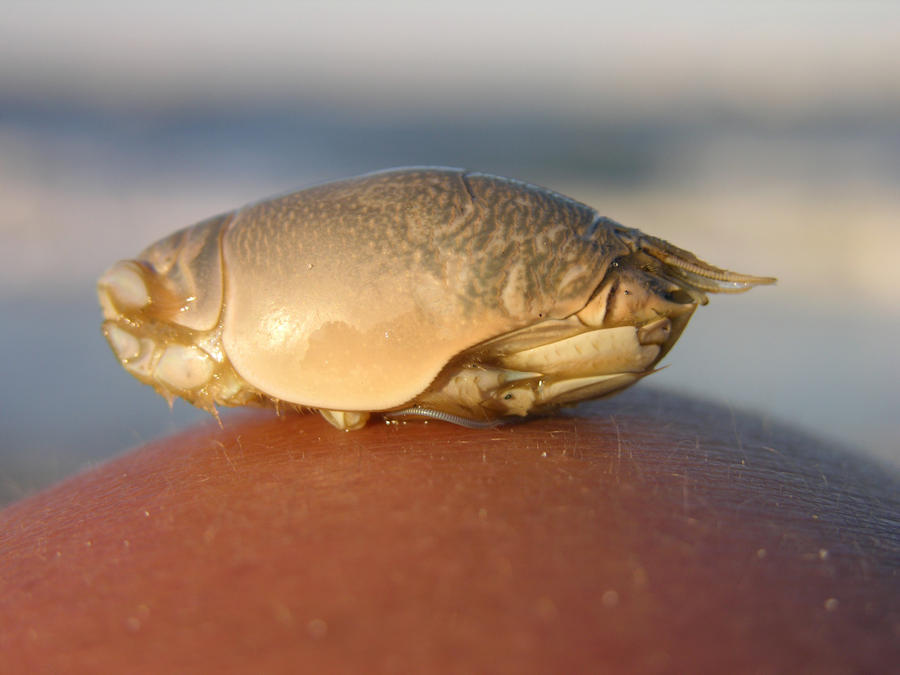
Emeridae are distantly related to giant crabs, lacking their cousins' pincers or widened stance in exchange for a hard, barrel-shaped carapace. Their limbs are long, hooked appendages which lock loosely into position underneath their bodies, allowing them to glide effortlessly across rushing sand or tides. An emeridae's eyes consist of a half-dozen black sprouts. A bundle rests on each side of the head, which projects through a thin hole bored on each flank. This peeking only occurs when submerged, preferring to otherwise keep their antennae safely within their shells.

An emeridae possesses twenty-two limbs of various sizes, most of which are specialized in digging through soft sediments. Using several shoehorn-like tools at the ends of their stems, they're capable of scooping considerable amounts of material from underneath. This allows entire packs to drop below the beach floor in just a second. They are slow creatures (no quicker than a moderately excited pig), but their movement potential increases exponentially once below ground.

Emeridae are Imps. There are many different kinds of imp — the majority of which being non-aware subspecies — that exist in discordant harmony throughout the realms. Many subspecies become cattle stock or mounts for various organizations, while others remain suitable as labourers within imp colonies. Imps have a word to distinguish these labour-beasts from other impkin ('Svnth' like Synth), a distinction most other cultures lack.


An average female grows between 0.9m and 2.0m (3 to 6.5 feet) in length, with males maturing somewhere just shy of their mates. Emeridae gather in packs, with egg-bearing mothers at the peak of its hierarchy. Emeridae give birth to clutches of bright, baseball-sized orange eggs, which they hold tightly against the undersides of their body. These eggs are brittle to the touch like hydrogel balls and a coveted ingredient in stews. They are violently protective of these clutches.

They are conscious but not intelligent. Imps possess a limited line of communication with them, which boils down to a limited form of speak with animals. Negotiating with an emeridae often revolves around the basic understanding of "leave us alone, and we'll leave you alone." They have no need for treasure but collect it in troves, both for clueless bedding and as a ribbon to bargain with. Emeridae dens lie several feet beneath the beach floor, massive dugout rooms held wide by whatever trash or treasure they manage to scavenge from adventurers. 

Emeridae Den Loot

1. A dead adventurer (50% still wearing their equipment).
2. 350sp in various coinage.
3. A half-eaten giant tuna.
4. A mage's lost robes.
5. Forgotten crates from a shipwreck.
6. A dead emeridae (25% of being female, holding eggs).

Round.

Don't mess with a mother and her children.

An emeridae has no concerns for the nature of its surroundings. All it wishes to do is live beneath its rocky beaches or sandy shores, utterly free of interruption, until the day its eggs hatch and it dies. They do not go out of their way to fight trespassers, often too busy hunting fish from the sands beneath the deep tide. This does not make them ambivalent. Those in a pack who are not spent hunting or digging their burrows will violently undermine those who step atop their grounds. Hunters of the emeridae's shells or eggs will oft find themselves sucked beneath the beach by the imp's talons. What limbs aren't tipped in scooping horns are adorned in frills and spikes.

The imps can clamber to the topmost layer of sediment, grab a fully-grown man with their claws, and then fall back beneath the sands in just over a second. They move through sand like water, grasp flesh like velcro. They do not consume human flesh, but their corpses still litter the burrows.

Beyond their own flesh and eggs, emeridae are considered valuable for their carapace, which possesses impressive durability while maintaining buoyancy. Witches will occasionally travel to beach burrows to dig for eggs, then used for alchemical purposes or bred as pets. A domestic emeridae provides an excellent familiar, serving as guard and breeding stock.

Emeridae can "coast" with the ocean tides, digging up to the surface whenever the waves wash or recede. This natural movement allows entire colonies to scurry from point to point. Sailors watch for Emeridae movements, tracking their round bodies flying down the beach as a sign of nearby fishing grounds. Imagine this but faster, larger, and with a lot more barbs.